The Cleveland Browns Are Building Something Real
The Trade That Changed Both Franchises
On June 1, 2026, the Cleveland Browns and Los Angeles Rams completed one of the most significant defensive trades in NFL history. Myles Garrett, the best defensive player in football, is headed to Los Angeles. What Cleveland gets back tells you everything about where this franchise is going.
Cleveland Browns
Cap Picture
Garrett was scheduled to carry a $23.5M cap hit for 2026. Andrew Berry waited until June 2 to officially file the trade with the league office, a calculated decision that secured the most favorable dead money split possible under the CBA. The Cleveland Browns will carry a $15.53M dead cap charge in 2026 and accelerate the remaining $25.56M into 2027.
This clears roughly $8.3M in immediate 2026 cap space. With Jared Verse crossing over to the Browns on his rookie contract with only a $2.17M cap hit for 2026 and $2.85M in 2027, the Browns gain massive financial flexibility on their books. By offloading Myles Garrett's deal they avoided a contract spike that would have become a $50M cap charge by 2030 which secures them an estimated $30M plus in long term cash savings to a team that will need capital for their young emerging stars.
The Browns' Side
Cleveland did not lose this trade. Jared Verse is only 25 years old, a former Defensive Rookie of the Year, and still on his rookie contract. He is an elite young edge rusher entering his prime on one of the most cost-efficient deals in football. The Browns get three years of cost control, with Verse hitting extension eligibility in the 2027 offseason after completing his third season, plus a fifth-year option for 2028 that is essentially a lock to be exercised given his production. This makes the trade even better for Cleveland than the surface numbers suggest.
The draft capital is what makes this exceptional. Two first-round picks in the 2027 draft is not just good value, it is a franchise-altering position for a team that has serious quarterback questions. The 2027 class is being talked about as one of the deepest quarterback classes in a generation. Arch Manning, Dante Moore, LaNorris Sellers, Julian Sayin, Darian Mensah, CJ Carr. The names at the top of this class have legitimate potential. Cleveland now holds two first-round picks to go after one of them, and the flexibility to trade up if needed.
While it is initially surprising that Les Snead did not yield an extra premium draft pick for the best defensive player in football, the total package of an established young edge in Verse plus three picks across consecutive drafts is an elite haul. For a front office that is rebuilding the team and building a sustainable championship window rather than desperately chasing one, moving Myles Garrett at this moment was the right decision for the long-term future of this franchise.
Los Angeles Rams
The Cap Picture
The Rams’ onboarding of Garrett’s contract is a masterclass in aggressive, window-maximizing cap manipulation. By altering his 5-year, $204M deal rather than a complete rework, the front office deferred the immediate cap strain to maximize their short-term financial leverage. Garrett’s actual cash payout for 2026 raises from $31.5M to approximately $37M via an accelerated option-to-signing bonus conversion, which means they are borrowing money from future years to reward him with an immediate $5.5M cash raise upfront.
The Rams inherit an incredibly suppressed cap schedule. Garrett hits the Rams' books at an incredible value of just $8.14M in 2026, $16.06M in 2027, and $21.38M in 2028. Moving the vesting date of his contractual guarantees back a few months allowed general manager Les Snead to cleanly absorb this record-setting deal without suffocating the cap space needed for upcoming extensions for core 2023 draft picks like Puka Nacua and Kobie Turner.
The adjusted guarantee timelines preserve absolute structural control, ensuring a clean off-ramp or leverage-heavy restructure window after two seasons. It is an all-in cash commitment, but one configured with precise structural protections for the team's long-term cap leverage.
The Rams' Side
Los Angeles just built an elite defense. Myles Garrett commands double teams on every play. He forces offensive coordinators to game plan specifically around him. That impact cannot be overstated. Matthew Stafford has two, maybe three seasons at this level. The 2027 first-round pick and 2028 second-round pick the Rams are sending to Cleveland are real assets, but for a franchise in a Super Bowl window right now, acquiring the best defensive player in football is worth that price. Trading those picks for Garrett makes sense in a way it would not for most franchises.
Trading Verse had to hurt. He is 25, still developing, still cheap. But when Myles Garrett is available, you do not wait. The Rams had already made a statement in March, acquiring All-Pro cornerback Trent McDuffie from the Chiefs on a four-year, $124M extension, the richest cornerback deal in NFL history. Adding Garrett to that secondary makes this a legitimate Super Bowl-caliber defense. Their window is open right now and they increased their chances significantly.
Building Toward Contention
The Browns went 3-14 in 2025. That record obscures what Andrew Berry has actually done to this roster. Cleveland fired Kevin Stefanski and brought in Todd Monken, who comes from Baltimore with a track record of building explosive, personnel-driven offenses. They spent heavily to reconstruct an offensive line that was one of the worst in football. They won back to back NFL drafts, adding legitimate talent across every position group in consecutive years and doing it the right way by building through the draft. They now have one of the youngest rosters in the NFL and a front office that is clearly building toward something real.
The AFC North is a brutal division known for its physicality, tough football, and consistently high stakes matchups. Cleveland is not winning this division in 2026. But this team is further along than the record suggests, and if quarterback play takes a step forward, a 7 to 10 win season is within reach. More importantly, the foundation for the future is being built right now.
The Moves That Changed This Roster
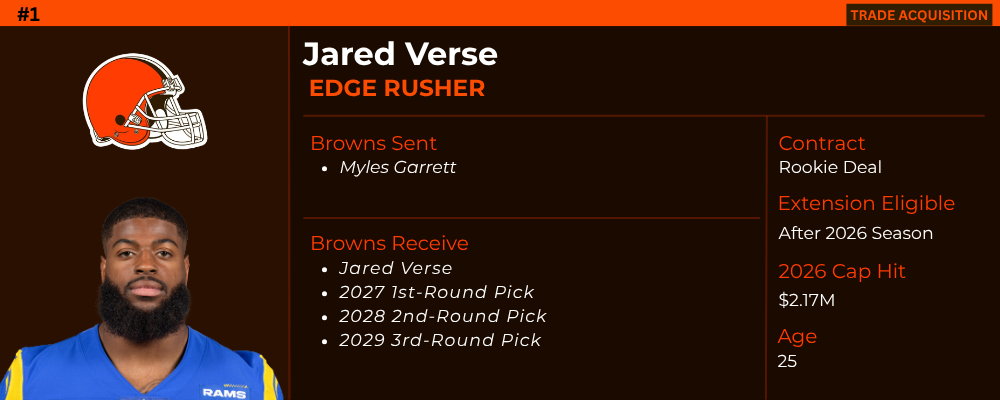
Jared Verse is only 25 years old and has not even come close to hitting his peak yet. He continues to get better year after year and has already shown he is a true top end edge rusher in this league. Adding another young ascending piece to that defensive line alongside Mason Graham is massive for the future of this defense. This trade gets better the longer you look at it.
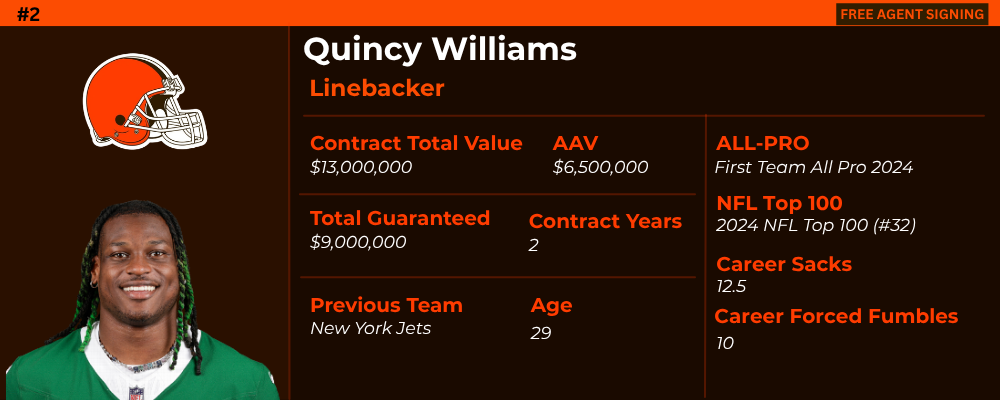
Quincy Williams still has elite play in him and last season with the Jets was not a fair representation of who he is. The organization made controversial decisions including trading his brother Quinnen Williams and Williams was playing under a completely different coaching staff with different responsibilities than what made him so effective. A fresh start in Cleveland is exactly what he needed. Paired alongside Carson Schwesinger, this linebacker room has the makings of one of the best duos in the NFL. With Mason Graham and Jared Verse commanding attention up front, Williams and Schwesinger will have the freedom to make reads and fly to the ball.
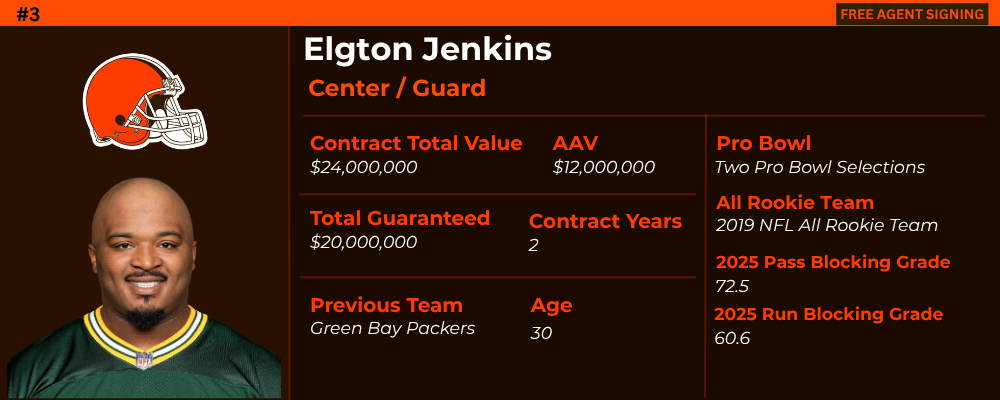
Elgton Jenkins is a versatile and experienced veteran who brings immediate stability to an offensive line that desperately needed it. His final season in Green Bay was derailed by a lower leg fracture and ligament damage in his ankle, but he is fully healthy now and a bounce back year is well within reach. He has shown his best football at guard and that is where we have seen him perform his best, but his experience and skill at center in Cleveland is a significant upgrade over what the Browns previously had at that position. His veteran experience and ability to play multiple positions on the line makes him one of the most valuable pieces of this entire offensive rebuild.
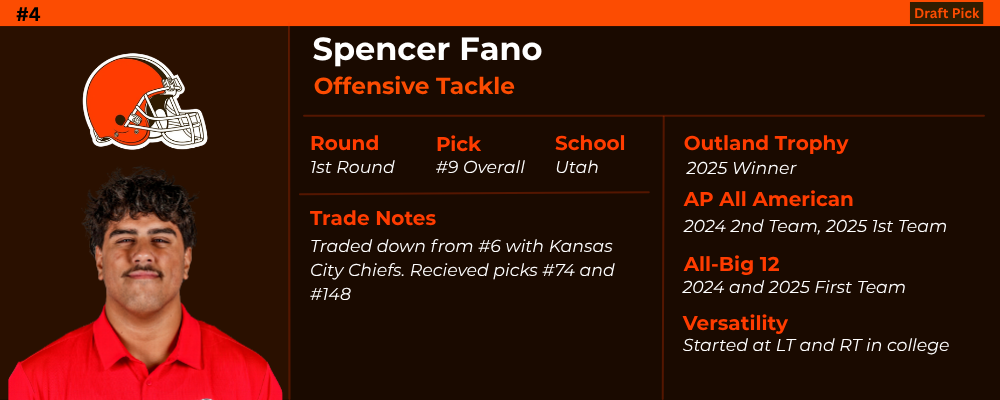
The Browns were able to trade down from pick six to pick nine with the Kansas City Chiefs, collecting the 74th and 148th overall picks in the process, and still landed the player they almost certainly would have selected at six anyway. Spencer Fano is a versatile and athletic offensive lineman who can play across every position on the line. He has the anchor strength to hold up against powerful edge rushers and the athleticism and footwork to mirror and shut down speed rushers. He will begin his NFL career at left tackle and I believe he will hold down that position as a starter for years to come in Cleveland.
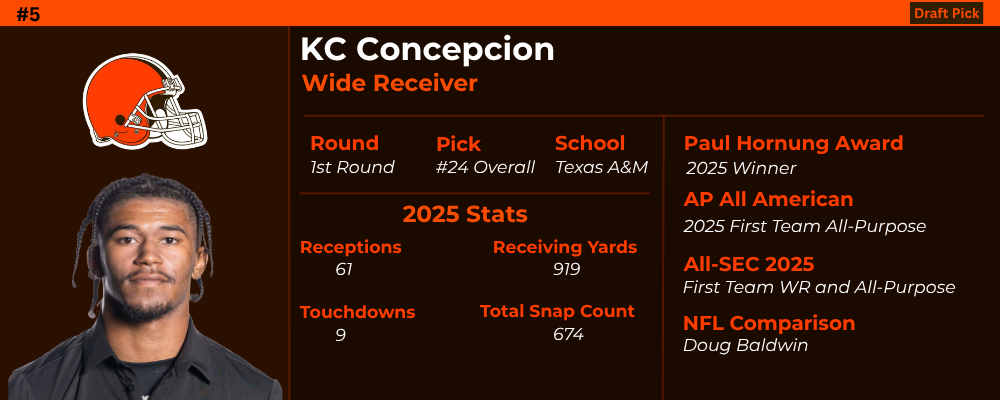
KC Concepcion will provide immediate playmaking ability that Cleveland desperately needed at the receiver position. He has incredible playing speed and burst and when the ball is in his hands he shines. He is elusive, creates separation, and at times appears genuinely unguardable. What makes this addition even better is that he was drafted alongside Denzel Boston, meaning neither receiver is being asked to do everything. Concepcion can be the yards after catch, shifty playmaking receiver while Boston fills the contested catch and red zone role. They will both thrive because they complement each other perfectly.
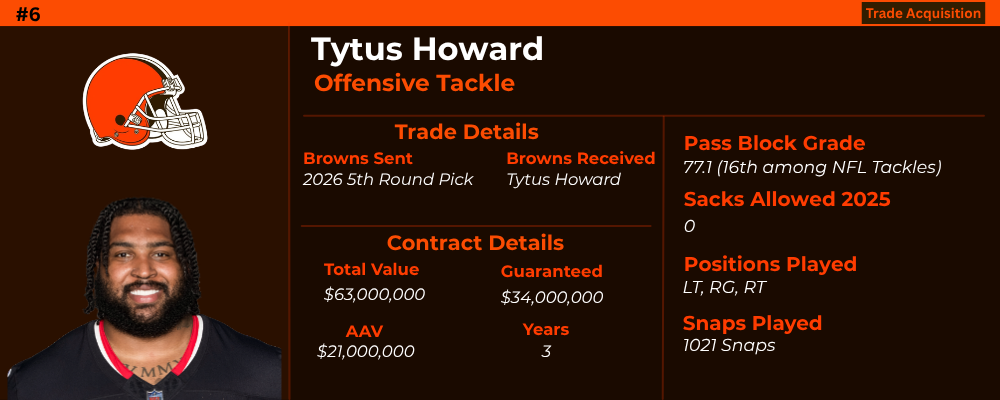
Tytus Howard was acquired from the Houston Texans for a fifth round pick and immediately addresses one of the most glaring needs on this roster. What stands out is his ability to protect the quarterback, something the Browns desperately lacked last season. He has the tools and physicality to anchor the right side of the offensive line and can shut down edge rushers in both power and speed situations. His veteran experience is incredibly valuable, particularly because he has played multiple positions on the line and brings a greater understanding of the entire unit and its responsibilities. He will be a strong veteran presence and a leader in that room.
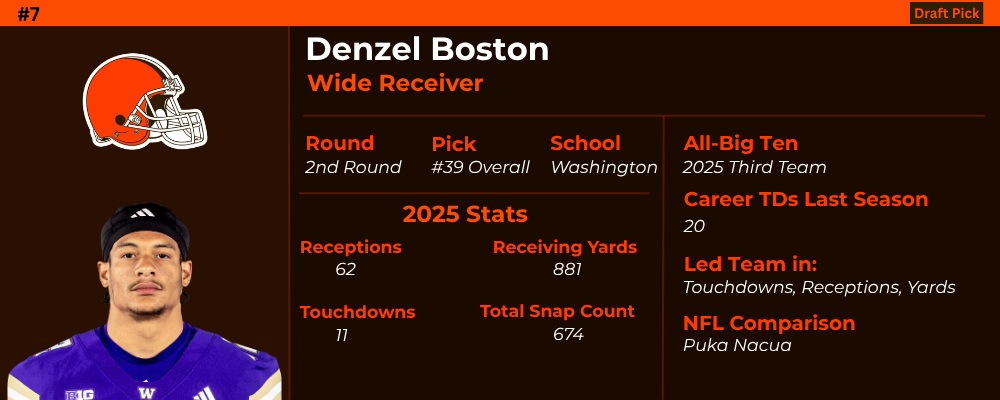
What stands out watching Denzel Boston is not his speed or athleticism but his strong hands, his ability to track the ball in the air, and his willingness to come down making hard physical catches in traffic. He will thrive given jump ball opportunities and contested throws and is an outstanding red zone threat. Drafting him alongside KC Concepcion was a brilliant move by Andrew Berry because both players can operate in their natural roles. Boston does not need to be the elusive playmaker and Concepcion does not need to be the contested catch receiver. They each do what they do best and this offense benefits enormously from that clarity.
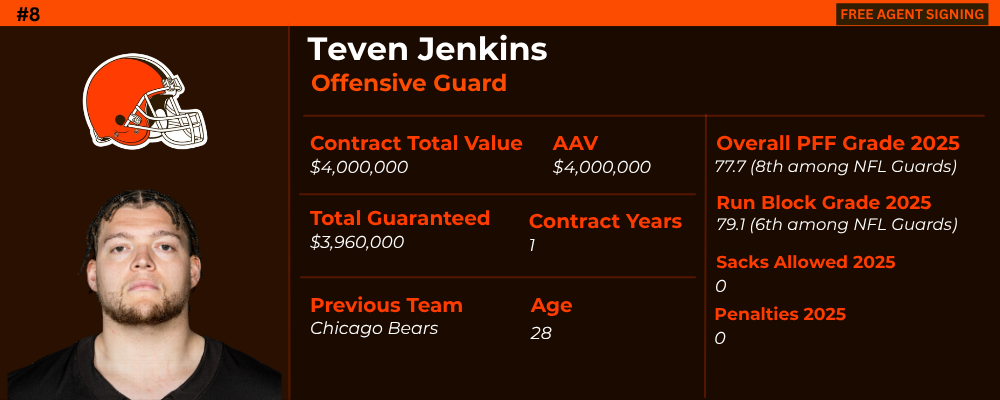
Teven Jenkins signed a one year deal worth $4 million with $3.96 million fully guaranteed and brings another versatile piece to an offensive line built entirely around flexibility. He has shown his best football at guard, which is where he will play in Cleveland, and he is a powerful, physical lineman with strong run blocking ability. He has battled injuries throughout his career and has yet to fully unlock his potential, but being surrounded by Elgton Jenkins, Tytus Howard, Spencer Fano, and Zion Johnson gives him the best environment he has ever been in. This offensive line has the potential to be among the best in football and Teven Jenkins is a part of that. This was an outstanding low cost signing that most people overlooked.
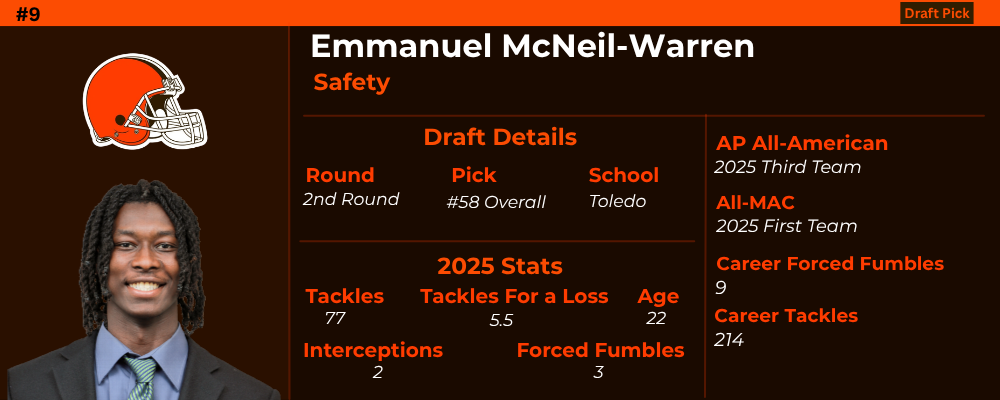
Emmanuel McNeil-Warren is a long, downhill safety who is a difference maker in the run game with his physicality and enforcer style of play. He has shown he can excel when playing close to the line of scrimmage and has also demonstrated the range to play deep when needed. Cleveland was an ideal landing spot given the style of safeties already in this room and a defense that has consistently thrived with hard hitting, downhill defenders. While he is capable of starting immediately, bringing him along in a rotational capacity to start will allow him to grasp NFL speed and get truly comfortable, which is best for his long term development. This was outstanding value in the second round and the timing could not be better for a Browns team with two safeties entering the final year of their contracts.
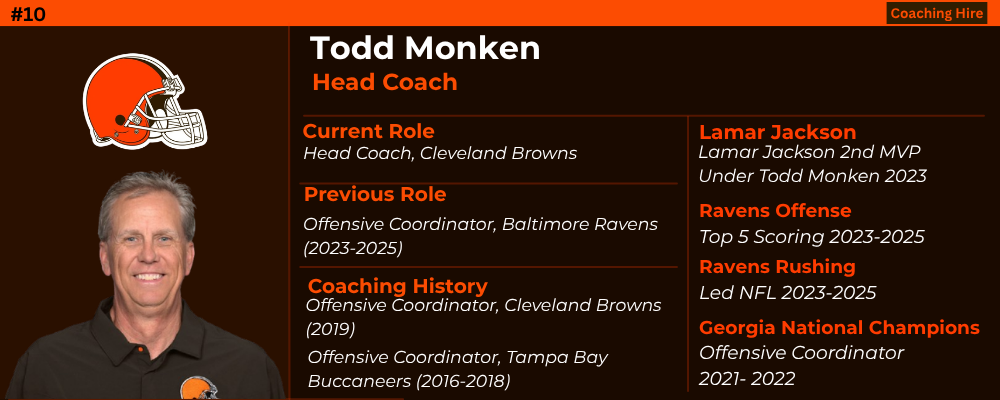
Todd Monken is one of the most respected offensive minds in football and bringing him in as head coach signals a clear commitment to building an offense capable of developing a young quarterback. He has extensive experience calling plays at the NFL level with the Tampa Bay Buccaneers from 2016 to 2018, the Cleveland Browns in 2019, and the Baltimore Ravens from 2023 to 2025. He is creative in his play calling, particularly in the passing game, making creative use of tight ends and athletic pulling guards in the run game. During his time as the Ravens offensive coordinator, Lamar Jackson had the best passing season of his career, secured his second MVP, and helped Baltimore finish as a top five scoring offense while leading the league in rushing. That track record of quarterback development is exactly what Shedeur Sanders needs. With difference makers across the roster in Quinshon Judkins, Dylan Sampson, Harold Fannin Jr., Jerry Jeudy, Denzel Boston, and KC Concepcion, Todd Monken has the weapons to build something special in Cleveland.
The Defense: Young, Hungry, and Rising
Losing Garrett does hurt. He is a true game changer, recording 23 sacks in 2025, setting the NFL single-season record. His ability to command double teams and alter the entire structure of an offense is rare. There is no direct replacement for that, but what Cleveland has got in return for trading him and what they have built at every other level of this defense is genuinely exciting.
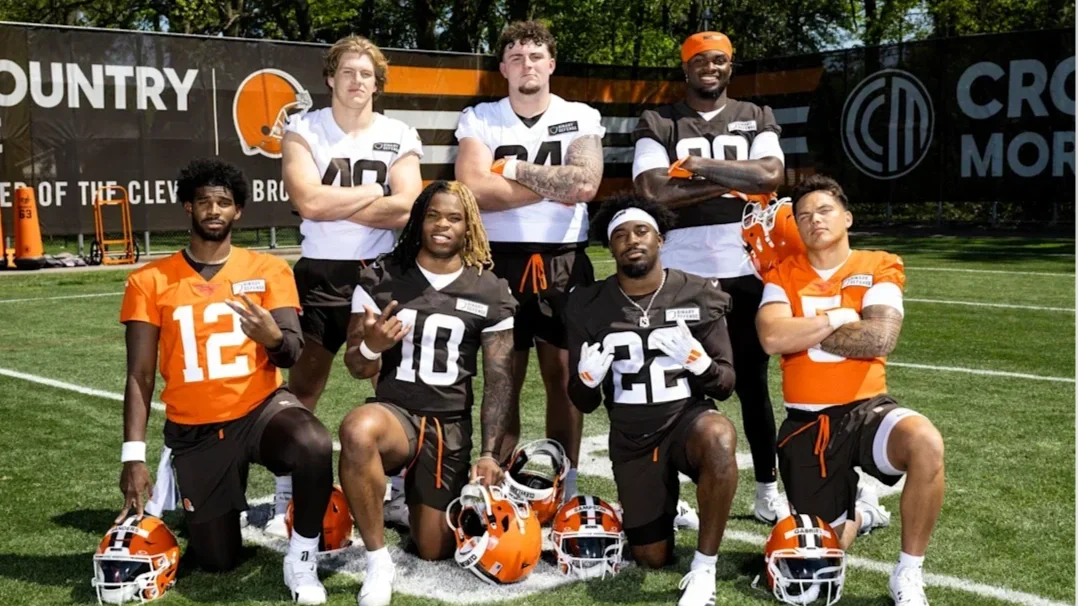
Photo of 2025 Cleveland Browns Draft Class via Cleveland Browns
Jared Verse steps in as the new anchor of this defensive line. At 25 with a Defensive Rookie of the Year award and 7.5 sacks in 2025, he is a true top tier edge rusher who still has yet to hit his peak and has all the talent to grow. His development over the next two seasons alongside this young core will be one of the most interesting storylines in the AFC.
Opposite Verse, Alex Wright continues to develop into a reliable and steady presence on the defensive front. Coming off a season with 7 sacks and 22 pressures, Wright signed a three-year, $33M extension with $21.3M guaranteed, securing him as a long-term piece of this defensive line. He has good length, the power to push tackles back, and ranks 17th among all qualified edge defenders in run defense effectiveness. He is not a headline name but he is exactly the kind of consistent, high-effort player that makes a defensive line function. With Mason Graham developing alongside him and Verse now opposite, Wright is in the best situation of his career.
Mason Graham at defensive tackle is a future cornerstone of this defense. He played in all 17 games as a rookie, recording 49 tackles, 7 tackles for loss, 4 passes defensed, and 0.5 sacks. The sack number has drawn criticism but it completely misses the point. Graham led all rookie interior defensive linemen in snaps played at 763. He recorded 36 quarterback pressures, second only to Myles Garrett on this entire roster. He graded excellently against the run as the season progressed and it was later reported he played through a broken rib suffered in Week 16. His impact on the game extends beyond what shows up in a box score. He commands consistent double teams, creates openings for teammates, and disrupts the interior with his presence alone. With a full season of NFL game speed behind him and a full training camp ahead, the development trajectory here is elite.
Carson Schwesinger is a linebacker who plays with elite instincts and football IQ that you simply cannot coach. He is rarely fooled by misdirection. He does not bite on pump fakes. When he is pressuring the quarterback, he reads the pocket and reacts in real time. He wore the green dot as a rookie, relaying play calls for the entire defense, which tells you everything about how quickly this staff trusted him. He won Defensive Rookie of the Year and he will develop into one of the best linebackers in the NFL. Pairing him with Quincy Williams on a two-year, $13M deal is remarkable value. Williams is an All-Pro caliber linebacker and the Browns got him at a price that should not have been possible. That pairing is going to cause problems for opposing offenses all season.
Denzel Ward is still an elite cornerback. He has the playing speed and fluid coverage ability to lock down any wide receiver in the NFL, and the respect he commands around the league reflects that. Coaches, executives, and elite receivers consistently name him as one of the hardest matchups in football. He is a consistent threat in the passing game, recording high pass-breakup numbers year after year. His 2026 cap hit approaching $31M is a real number but the production has always justified it. The concern with Ward has never been talent, it has always been durability. When he is on the field he plays at an elite level. Keeping him healthy over a full season is what separates a good Browns secondary from a great one.
Alongside Ward, Tyson Campbell fits this scheme better than he ever fit Jacksonville's. His run-defense grade of 77.5 ranked 16th among all NFL cornerbacks in 2025 and his 65 solo tackles ranked 9th at the position. He was at his best pressing receivers and disrupting timing at the line of scrimmage. At 26 years old he needs to show more consistency in coverage to be truly reliable on the back end, but he is trending in the right direction and the fit within this scheme is clear.
Myles Harden has outperformed his seventh-round draft status and proven he belongs in this league. He is a physical and aggressive run supporter at the nickel who plays with above-average instincts and has been a reliable special teams contributor throughout his time in Cleveland. His limitations show up in coverage against elite speed and he has struggled at times with taking proper angles in the open field. He is not a top-tier starting nickel at this stage of his career, but he has already exceeded every expectation attached to a seventh-round pick out of South Dakota.
The safety room is one of the most underrated groups on this roster. Grant Delpit has established himself as a cornerstone of this secondary. He is a highly versatile and physical starting safety who can drop into deep zone coverage or play tight in the box depending on what the defense needs. He plays with intelligence and anticipation, is reliable in the open field, and has shown he can make tackles for loss when he closes on the ball. He is a genuine turnover threat with interceptions and forced fumbles. When healthy he plays at an All-Pro caliber level and he is entering the final year of a three-year, $36M extension. A re-up in the range of a three-year deal at $12.5 to $15M AAV makes sense for both sides, and this is one of the most important contracts Berry will negotiate this offseason.
Ronnie Hickman came in undrafted and built himself into a tone-setting defender who plays with elite physicality and instincts. Emmanuel McNeil-Warren, the second-round pick out of Toledo, had a first-round projection before slipping and brings similar athleticism and aggression to the position. The question going into 2026 is whether the Browns view McNeil-Warren as an immediate starter who can step into a primary role, or whether they keep Hickman and develop McNeil-Warren through a rotational path this season.
This defense is young and ascending. The pieces are in place.
The Offense: The Tools Are In Place
Last season Cleveland quarterbacks had no time to throw. The offensive line was a liability from snap to snap, cycling through ten different starting combinations due to injuries and inconsistency. That era is over.
The Offensive Line
The most important theme in how Andrew Berry built this offensive line is versatility. Every piece they added can play multiple positions.
Spencer Fano, the ninth overall pick out of Utah, will play left tackle but can line up anywhere on the line. Elgton Jenkins, signed to a two-year, $24M deal with $20M guaranteed, is among the most versatile linemen in football. He has shown All-Pro level play at guard and is now being asked to anchor at center. His 2025 season with Green Bay was rough, but context matters. He was surrounded by instability and injuries. In a structured environment alongside proven talent, he is a different player.
Tytus Howard at right tackle, acquired from Houston and extended at three years and $63M, brings the elite edge protection this offense desperately needed. He ranked 17th among all NFL tackles in PFF pass blocking in 2025. Teven Jenkins adds another versatile interior option though durability remains a real concern. Kendrick Green as a backup provides rotational depth and Austin Barber, the third-round pick out of Florida, is an athletic developmental tackle with the size and mobility to grow into a starter.
The biggest concern in this group is Zion Johnson. The Browns gave him a three-year, $49.5M deal despite a difficult 2025 campaign with the Chargers. He was operating in an inconsistent, rotating unit all season in Los Angeles, depleted by injuries at both tackle spots. Paired with stability and veteran presence, his production could look dramatically different. But this is a contract that needs results in 2026 to justify itself.
The Wide Receiver Room
This group went from a weakness to a strength in one offseason.
KC Concepcion with the 24th pick is a true playmaker. Shifty, route-savvy, electric after the catch. Denzel Boston at pick 39 is a 6-foot-4 jump ball receiver who wins contested catches. What makes this combination so valuable is that neither is being asked to carry the room alone. Concepcion can be the dynamic, hard-to-guard slot threat. Boston can be the aggressive downfield target. They each fill a specific role and play to their strengths without overlap.
That reality also takes pressure off Jerry Jeudy, who is a prime bounce-back candidate under Monken's system after two seasons of poor quarterback play and an unstable line. Jeudy's separation skills are real and a healthy, coherent offense should unlock them. Isaiah Bond provides depth and legitimate upside. Cedric Tillman, entering the final year of his rookie deal, is the odd man out with $3.67M in base salary and zero guaranteed money remaining. He is a real trade candidate.
The Backfield and Tight End
Quinshon Judkins is the foundation of this running game. Before dislocating his right ankle and fracturing his fibula in Week 16 against Buffalo, he was proving himself to be a serious NFL back with legitimate talent. Reports indicate he is fully recovered. Dylan Sampson at 21 years old is the ideal complement: fast, versatile, effective as both a runner and a pass catcher. These two were at their best when both were healthy and on the field together. Getting both healthy for a full season is a difference-maker.
Harold Fannin Jr. at tight end is going to continue to surpass expectations. His physicality, his run blocking, his ability to threaten the seam and work underneath. He has a combination of skills and traits that are rare for his position. For his size, the athleticism and speed are genuinely shocking. He has the talent and skill to be in the conversation among the elite tight ends in the NFL and the early production indicates he is more than capable. With David Njoku gone, he is being asked to carry that room and he looks ready to do it.
The QB Battle: Everything Depends on This
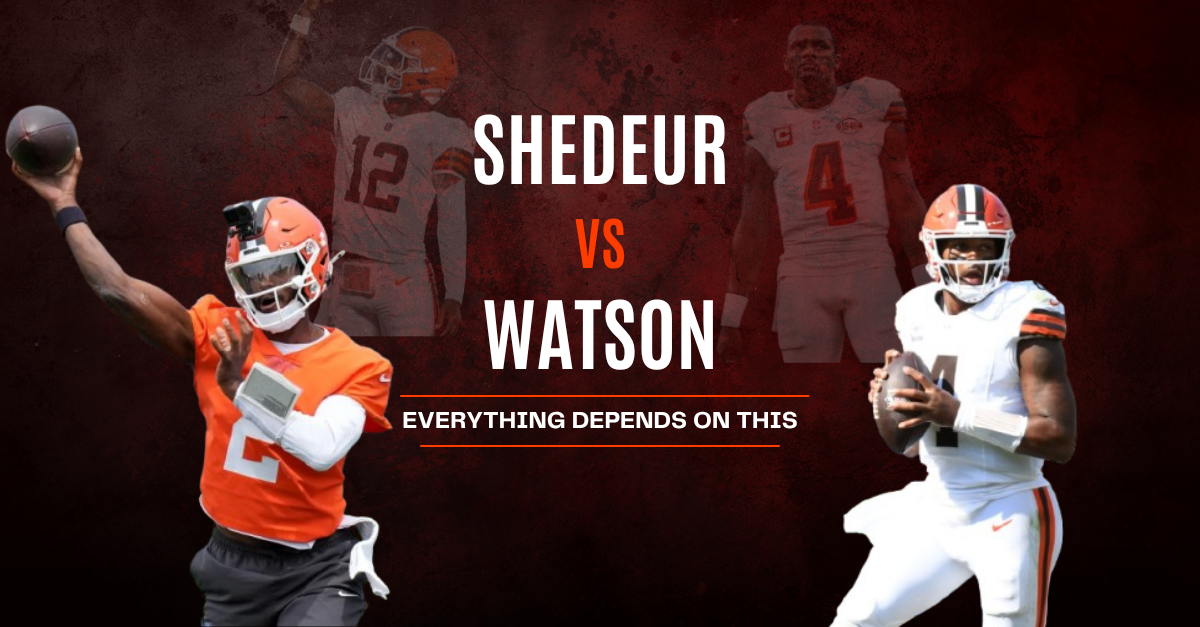
Shedeur Sanders has the talent and skill to win this job and command this offense.
The adversity he faced in 2025 was extreme. He was not given reps with the first or second team. He was thrust into the starting role mid-season with no real preparation and showed development in every single game. He takes hits and gets right back up. He plays with poise and confidence that does not waiver under pressure. His anticipation as a thrower and his accuracy in the intermediate areas of the field is impressive. In college he had a tendency to extend plays too long and take avoidable losses, but watching his 2025 film with Cleveland you can see him learning when to pull it down and when to stay in the pocket. That growth under these extreme circumstances tells you something about who he is and the player he can grow into.
With a full training camp, a completely rebuilt offensive line, legitimate weapons around him, and a staff that was installed specifically to develop a quarterback, Shedeur Sanders is in the best position of his career. If he takes the next step he could be the franchise quarterback this organization has been searching for.
“Shedeur’s come miles, in terms of his progressions, getting the ball out, his understanding of concepts. I think he’s really, really come a long way… They’ve both played well enough to earn the right to compete to start.”
Deshaun Watson is the wildcard. When he was with Houston he was playing at a truly elite level, one of the best quarterbacks in football. Then came the off-field issues, the injuries, and years of inconsistency. He is returning from a ruptured right Achilles that he re-tore. His mechanics, deep accuracy, and pocket presence have all been questioned since coming back. If the Watson we saw from Houston shows up this training camp, the conversation changes entirely. But the questions are real and this organization has to be honest with itself about what it has seen from him in Cleveland.
Whoever takes the reins in 2026 is in a far better position than any Cleveland quarterback has been in years. The offensive line is completely different. The skill positions are legitimate. The scheme is designed to support a quarterback, not ruin one. And if neither Sanders nor Watson is the long-term answer, the quarterback this franchise drafts in 2027 will enter an exceptional situation with talent across every position group and a roster that will only continue to improve. The ceiling of this offense is directly tied to who lines up under center on opening day.
The Cap Picture
The Browns currently carry approximately $18.6M in available cap space alongside $116.78M in dead cap, the second-highest total in the NFL. That dead cap is the cumulative cost of years of aggressive cash-over-cap spending through void years and restructures. Joel Bitonio, David Njoku, Wyatt Teller, and now Myles Garrett, the exits were necessary but expensive.
Watson's $44.96M cap hit in 2026 is the heaviest weight on the books. His contract was specifically structured with a post-June 1 release mechanism for 2027. When that release executes, the $86.2M in remaining dead money splits to $34.66M in 2027 and $51.54M in 2028. That is painful but manageable against a salary cap that has been growing at roughly 8% annually.
The outlook beyond 2026 is encouraging. Projected 2027 cap space lands around $44.6M despite the Garrett and Watson dead money. By 2028 the books clear substantially with projected space near $103M. That financial flexibility arrives exactly when Verse's extension window peaks, giving Berry the room to lock in one of the best young edge rushers in football before the market resets.
Expiring Contracts After 2026: Re-Sign or Move On
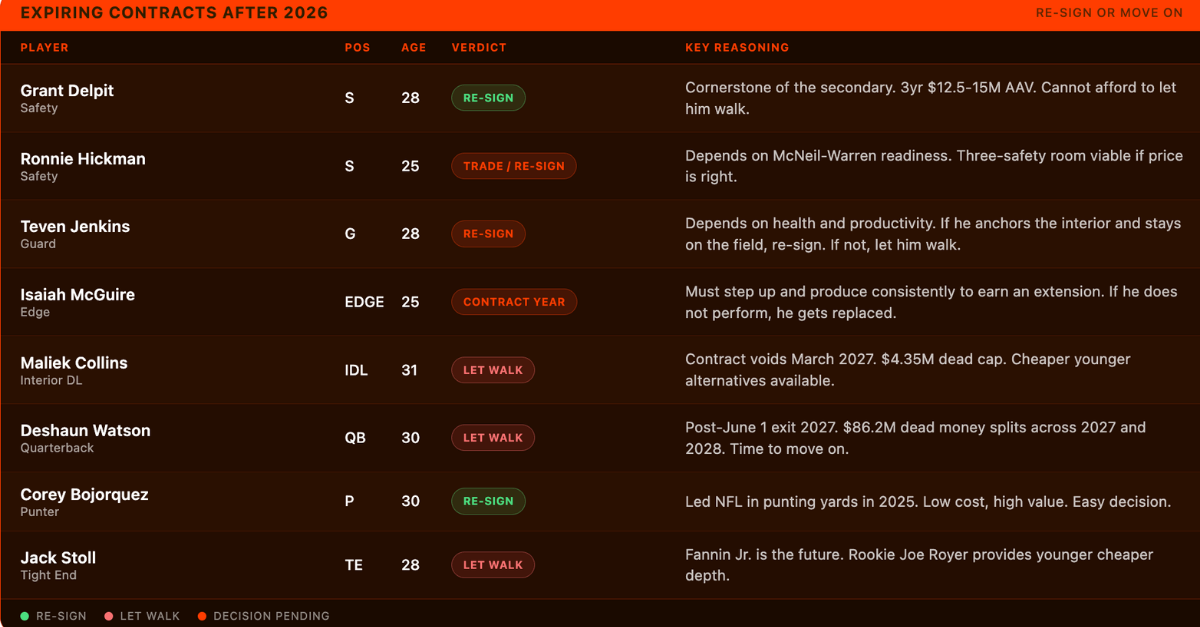
Grant Delpit is a legitimate starting safety and a cornerstone of this secondary. A three-year deal in the $12.5 to $15M AAV range is the right structure. Letting him walk would create a hole this roster cannot afford going into a critical 2027 season.
Ronnie Hickman is a different conversation. If the Browns trade him before the deadline, this section closes itself. If he is still on the roster at season's end and delivers another strong year, the decision gets interesting. Cleveland should honestly consider continuing the three-safety room if Hickman can be retained at a reasonable value. If the market drives his price too high, let him walk and trust McNeil-Warren to step into a full-time role.
Teven Jenkins brings versatility that is too valuable to walk away from on a roster built around interior OL flexibility. His injury history should make the Browns hesitant to give him anything beyond a one-year deal even with a strong 2026 season. If he stays healthy and anchors the interior, bring him back. If not, let him walk.
Isaiah McGuire is the contract year name to watch on this entire roster. He needs to step up and produce consistently in 2026 to earn an extension. With Verse as the future of this defensive line, McGuire has to carve out a legitimate role or the front office will look elsewhere in free agency or the draft.
Maliek Collins is straightforward. His contract voids in March 2027, leaving $4.35M in dead cap. Mason Graham is ready to carry the interior and there are cheaper younger alternatives available in the draft and free agency.
Deshaun Watson's time in Cleveland has come to an end and this organization has to be honest about that. The off-field noise, the injuries, and the performance on the field when healthy have not inspired confidence that this is the same player from Houston. The post-June 1 release mechanism in 2027 is the clean exit. The Browns made a difficult decision trading for him and it did not work. It is time to move forward.
Corey Bojorquez led the NFL in punting yards in 2025. Low cost, high value. No reason to move on.
Jack Stoll is replaceable. Fannin Jr. is the future of this tight end room and rookie Joe Royer gives the Browns a younger cheaper option to develop behind him.
Trade and Cut Candidates
Bears
Chiefs
Jets
Jaguars
Giants
Tillman is the most likely to be moved before the season. His PPE-adjusted cap hit is $3.94M with zero remaining guarantees, meaning a trade saves Cleveland $3.67M with only $270K dead cap. He is a physical receiver with size who has shown flashes but cannot hold onto a primary role in this room. A fifth-round pick is a realistic return. The Commanders, Bears, Chiefs, and Jets all have receiver needs that Tillman could address as a rotational piece.
The math on keeping four quarterbacks does not work. Gabriel is in Year 2 of his rookie deal at a $1.42M cap hit. Trading him before the August roster bonus triggers saves $1.12M in 2026 with only $292K dead cap. The Cardinals and Jaguars are realistic trade partners. If demand is low, cutting him is the cleaner move.
Already addressed in the expiring contracts section, Hickman is worth revisiting here because he is the most realistic trade candidate on this roster, and not because of underperformance. He over-delivered as an undrafted free agent and has been one of the better stories on this roster. The question is whether the Browns view McNeil-Warren as an immediate starter who can step in and assume that primary role. If the answer is yes, trading Hickman while his value is at its peak makes real sense. A fourth-round pick with a seventh is the floor. Anything less and you keep him, develop McNeil-Warren in a rotational role, and revisit in the offseason. The Eagles make sense as a trade partner given their safety room situation. The Giants are another realistic destination given Harbaugh's preference for multiple safety bodies.
Cut him before camp and free the $1.075M. Logan Fano has a stronger case for that rotational edge spot and there is zero dead cap penalty.
Targets: Who They Should Add
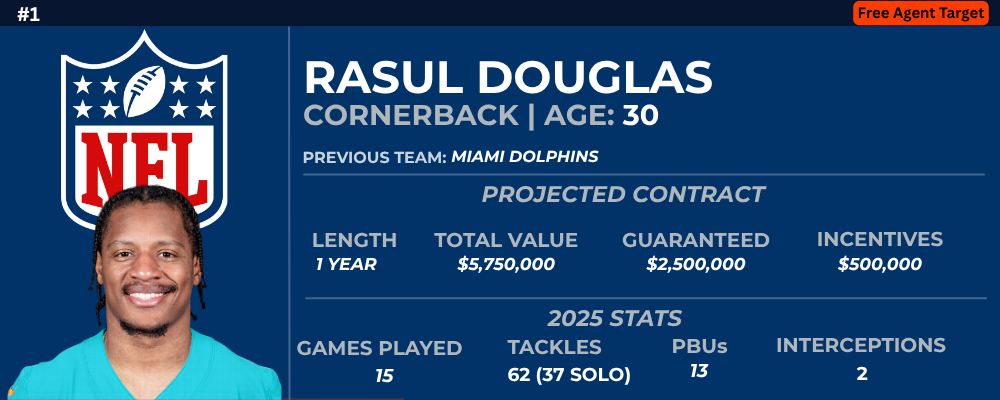
Rasul Douglas is one of the premier diagnostic zone corners in football and the fit with what Mike Rutenberg is building in Cleveland is hard to ignore. Rutenberg leans heavily on Cover 3 principles, and Douglas has spent his entire career excelling in vision and break coverages, reading the quarterback, squeezing vertical routes, and triggering downhill on breaking routes with elite anticipation. His 209 pound frame makes him a physical presence at the line of scrimmage and an aggressive run supporter, which fits directly into Rutenberg's philosophy of violence and high effort. With a 33.9 percent blitz rate, boundary corners are frequently left without safety help over the top and Douglas's length and veteran spatial positioning allow him to disrupt catch points without needing elite recovery speed. The depth argument alone justifies this signing. Denzel Ward has battled injuries throughout his career and Tyson Campbell, while improving, has shown inconsistency in coverage. Adding a high IQ plug and play boundary corner who seamlessly executes Cover 3 rules gives Cleveland a legitimate third option on the perimeter. His 2025 season with Miami told the real story: 72.7 PFF grade ranking 21st among 114 corners, 13 pass breakups, 2 interceptions, and a 72.6 passer rating allowed. At a projected one year deal in the $5.75M range this is one of the cleanest fits on this entire target list.
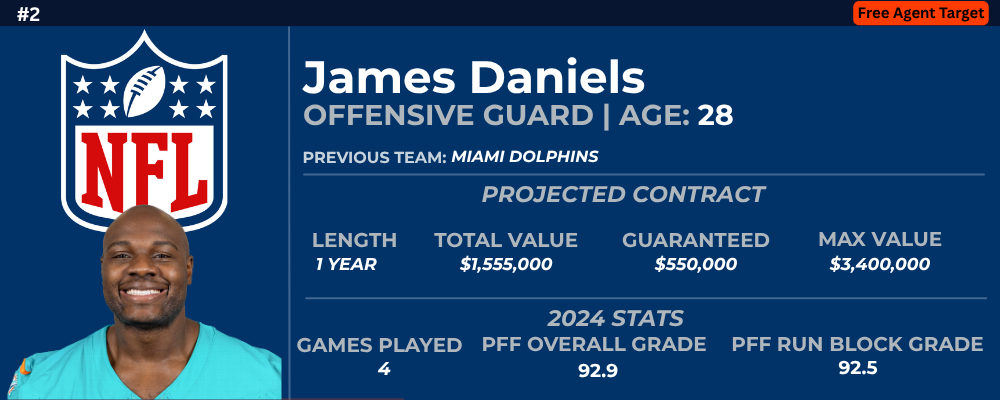
The injury concern with James Daniels is real and cannot be glossed over. He missed the entirety of the 2025 season with Miami after suffering a pectoral injury in Week 1 and lost most of 2024 with the Steelers to a season ending Achilles tear. But what Cleveland is looking for in Daniels is not a starter, it is a proven, experienced interior lineman who provides genuine security behind Zion Johnson and Teven Jenkins and can compete for the right guard role if either player struggles or goes down. At 6-foot-4 and 327 pounds with elite athleticism in space, quick hands, and the ability to create cutback lanes on outside zones, Daniels matches the exact profile the Browns have built this offensive line around. He is versatile, has played left guard, right guard, and center, he is a strong run blocker, and he is regarded as a high football IQ player and a strong locker room presence. The four game stretch before his 2024 Achilles tear tells you everything about his ceiling: a 92.9 overall PFF grade, a 92.5 run blocking grade, 0 penalties, and just 5 total pressures allowed in 209 snaps. He is only 28 years old and has years left. At a projected vet minimum deal with incentives this is one of the lowest risk highest upside depth signings available. This move also opens the door to move Zak Zinter, who has yet to find his role in Cleveland, for a fifth or sixth round pick or a positional swap in the cornerback or defensive tackle room.
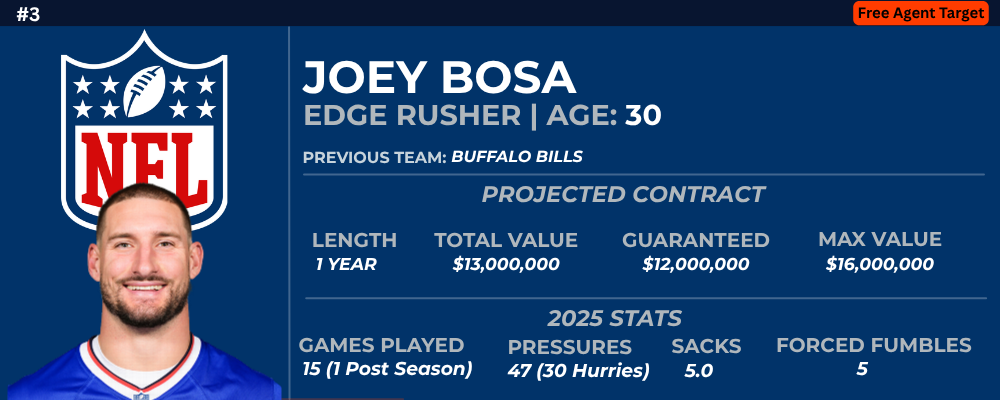
Even with Jared Verse stepping in as the anchor of this defensive line, the gap left by Myles Garrett cannot be ignored. Verse is an emerging elite edge rusher with a ceiling that has not been reached yet, but Cleveland needs another proven pass rusher in that rotation and Joey Bosa is the name that makes the most sense. In 2025 with Buffalo he recorded 5 sacks, 47 total quarterback pressures, and led the entire NFL with 5 forced fumbles while earning an 88.7 PFF pass rush grade in 15 games. That production in a situational role alongside Verse, Alex Wright, and Isaiah McGuire would give Cleveland a disruptive edge rotation. The reality is that Bosa may be looking for a multi-year deal or a more competitive window, and those are legitimate factors that could push him elsewhere. But if the Browns sell him on the vision, his role in the rotation, and a one year deal structured at $13M total with $12M guaranteed and up to $3M in NLTBE incentives that push into the 2027 cap, this becomes a financially manageable swing that does not handcuff the roster long term. The risk is real but so is the reward. A healthy Bosa in Cleveland makes this defense significantly harder to game plan against.
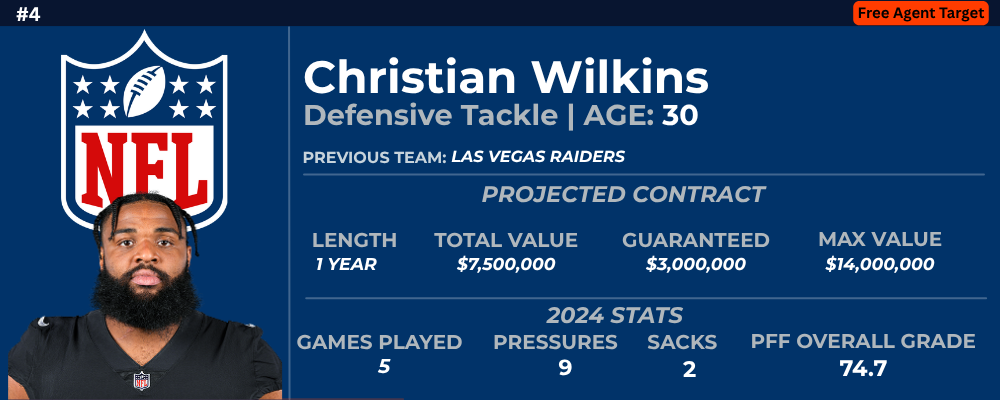
The defensive tackle room as currently constructed is heavily dependent on Mason Graham to carry the interior and while Graham has shown he is more than capable, adding a proven veteran alongside him changes this defensive front. At his peak Wilkins was logging 75 to 80 percent of defensive snaps, demanding interior double teams, recording 9 sacks and 61 pressures in his final season in Miami, and grading at an 80.2 PFF run defense grade through five games with the Raiders before the Jones fracture ended his season in Week 5 of 2024. When you place Wilkins alongside Graham you create a genuine problem for opposing offensive coordinators. Double team Graham and Wilkins and Verse are one on one. Double team Verse and Wilkins and Graham are collapsing the interior. There is no clean answer.
His presence alone elevates this defensive line from a group built around one young star to a genuinely dangerous unit. Wilkins brings elite culture and energy into a locker room, most who have played alongside him describe him as a high energy, high effort presence who makes a defense better simply by being in the room. While there was a locker room incident in Las Vegas that contributed to the end of his tenure there, the consensus was this situation was blown out of proportion. The best case is a refreshed, motivated Wilkins mentors Graham and helps this defense become a top five unit, and at the end of the season the Browns either re-sign him or let him walk and collect a high value compensatory pick. The worst case is the foot does not hold and he lands on injured reserve. At the right price the upside is too high to ignore.
A one year prove it deal with a base value of $7.5M, a $3M fully guaranteed signing bonus, $2M base salary, and per game roster bonuses totaling $2.5M at $147,058 per active game gives the Browns full financial protection if things go wrong. NLTBE incentives pushing the max value to $14M roll to the 2027 cap if earned, keeping 2026 books clean. If it becomes a bidding war the ceiling is a base value of $10M with a maximum of $18M and beyond that the Browns should look elsewhere.
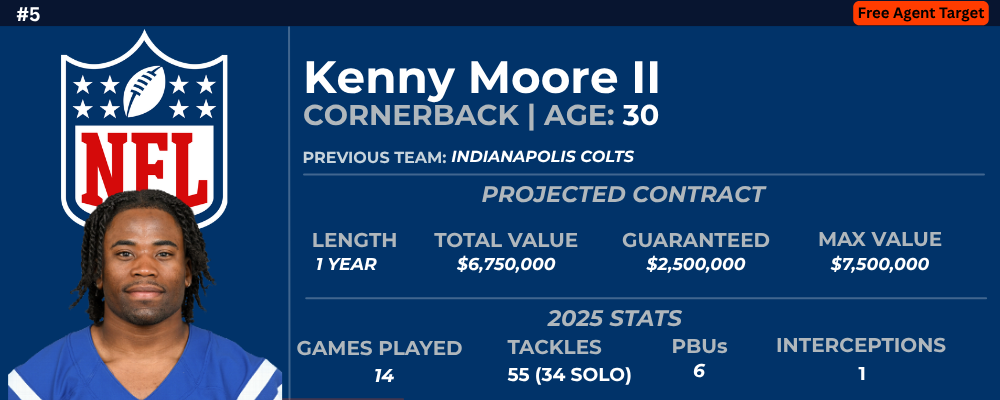
Cleveland's projected slot options heading into 2026 are Myles Bryant, a competent depth piece with athletic limitations, and sophomore Myles Harden, who has shown he belongs in this league but has not yet proven he can handle the full responsibility of the nickel role. Bringing in a veteran like Moore immediately elevates the floor of those sub-packages as Mike Rutenberg dials up blitzes at a high rate and Moore has historically been an effective slot blitzer, adding a deceptive chess piece to Cleveland's pressure packages. His 84.4 PFF run defense grade in 2025 ranked 5th among all NFL cornerbacks, which fits directly into what Rutenberg wants from his defense. He has been trusted by coaches and teammates to relay play calls, he communicates well pre-snap, and he brings the veteran presence and football IQ that a young secondary can build around. The risk is his age and declining recovery speed if asked to match elite slot receivers vertically in Cover 1 or Cover 3, but at a projected one year deal with a total value of $6.75M and only $2.5M guaranteed, the risk to reward is firmly in Cleveland's favor. If the Browns are not seeing what they need from their current nickel options, Kenny Moore is the right call.
The 2027 Draft Picture
Cleveland projects to hold approximately 11 picks in the 2027 NFL Draft, including two first-round selections: their own and the Rams'. That draft class is being discussed as potentially one of the best quarterback classes in years.
The top names have legitimate potential to be franchise quarterbacks. Arch Manning (Texas) has the arm talent and dual-threat ability to be the No. 1 overall pick if he builds on his 2025 season. Dante Moore (Oregon) is a natural passer who returned to school despite being in contention for the top pick last cycle. LaNorris Sellers (South Carolina) has elite arm power and mobility. Julian Sayin (Ohio State) is the most accurate passer in the class at 77% completion percentage though his arm strength and size create questions. Darian Mensah (Miami) is a fluid, mechanically sound passer who was nearly automatic in the red zone last season. CJ Carr (Notre Dame) is drawing first-round buzz from scouts already.
Cleveland holds two first-rounders going into this class regardless of what happens in 2026. Even if both picks land in the mid-range, the Browns have the flexibility to consolidate draft capital and move up for the quarterback they want. Andrew Berry will be drafting the Browns' franchise quarterback in next year's draft.
The Bottom Line
The biggest question remaining for the Cleveland Browns is simple: who is your quarterback?
Everything else Berry has built suggests a team that is ascending. The defense is young, physical, and talented with legitimate stars emerging at multiple positions. The offensive line is completely rebuilt around versatility and depth. The receiving room is the best it has been in years.
If Shedeur Sanders takes the next step with a full training camp, a rebuilt line, and real weapons around him, this offense looks different than anything Cleveland fans have seen in a long time. If Watson somehow finds the version of himself from Houston, the Browns can stop looking at the 2027 draft class entirely.
If neither Watson nor Sanders proves to be the answer in 2026, Berry has two first-round picks pointed directly at a historic quarterback class. The plan accounts for every outcome.
Cleveland is not a Super Bowl team in 2026. They are a 6 to 9 win team with a chance to surprise people and a front office doing exactly what you want a rebuilding organization to do. The pieces are young. The draft capital is loaded. And after years of questions surrounding the quarterback position, aging rosters, and financial mismanagement, the Browns finally look like a team with a real future.
