The Jets' Future Has Never Looked Brighter
Building Toward Contention
The record says 3-14. The roster says something completely different.
Darren Mougey and Aaron Glenn looked at a 3-14 roster and made tough roster altering decisions. Trading Sauce Gardner four months after making him the highest-paid cornerback in NFL history looked like a panic move. And then moving Quinnen Williams to Dallas, this looked like a full teardown. What those trades actually look like now: Kenyon Sadiq, D'Angelo Ponds, Adonai Mitchell, and two additional first-round picks in the 2027 draft.. This puts the Jets in a great position to rebuild the Jets roster the right way rather than being reliant on two all pro players to carry the roster.
The same rebuilding mentality carried into the front office and coaching rooms. Steve Wilks former defensive coordinator got fired in December after a 48-20 loss to Jacksonville. Tanner Engstrand, former offensive coordinator, parted ways after the offense finished 29th in scoring and dead last in passing yards. Glenn responded by hiring Frank Reich to run the offense and promoting Brian Duker to defensive coordinator, both with direct ties back to his own coaching tree. Glenn will call the defensive plays himself heading into year two.
The roster and staff changes are only a fraction of the story. This front office has built a financial structure that sets them up for success in the upcoming years. The Jets are carrying one of the largest dead cap charges in the league right now, driven mostly by the remaining Aaron Rodgers and Justin Fields charges, so they can walk into 2027 with clean books and three first-round picks sitting on top of it. They absorbed the criticism and short term pain to set them up for future success because they had a plan and aligned vision.
General Manager Darren Mougey: The Mentality Behind the Rebuild
Darren Mougey is one of the youngest general managers in football, and his path tells you exactly how he thinks. He started as a scouting intern with Denver in 2012, hired by John Elway, and spent over a decade working through every level of that organization before becoming assistant general manager in 2022.
His stated philosophy is simple. Draft, develop, keep our own, and be disciplined in free agency. The proof is in what he actually did. In his first two years he completed six extensions for homegrown players. Former General Manager Joe Douglas and Former General Manager Mike Maccagnan combined for seven extensions over nine seasons, and Douglas only completed one for a player his own front office drafted. Mougey tripled that pace in a fraction of the time, and he did it for the right players. Joe Tippmann, Jeremy Ruckert, Breece Hall, Garrett Wilson, Josh Myers.
The part of his process that I find genuinely fascinating is the scouting overhaul. Mougey did not have time to rebuild the evaluation system before his first draft in 2025 because he was hired so late in January. So he waited, ran a multi-week collaborative process with his own scouts pitching ideas from their own backgrounds, and built a completely custom grading scale with proprietary color and numerical schemes. He brought in Chris Miller Senior Developer for Football System and Chief Data and Analytics Officer Iwao Fusillo to rebuild the IT infrastructure behind it, automated over twenty operational workflows including medical data extraction from the combine, and got over ninety percent of the building using daily AI tools to speed up scouting research.
The 2025 Draft Class That Set This Up
Before any of the 2026 headlines, this rebuild already had a foundation, and it does not get nearly enough credit.
Armand Membou is the headline of that 2025 class. He started all 17 games as a 21-year-old rookie right tackle, played 1,047 of the offense's 1,048 snaps, and posted a 91.7% pass-block win rate. PFF graded him 72.7 overall which ranks 31st among 89 qualified tackles as a rookie, and the second-highest mark among all rookie offensive linemen leaguewide. He was one of only two rookies in the league to play 1,000+ snaps with a 70.0+ overall grade.
The rest of that 2025 class is why this team has the flexibility to be aggressive right now. Mason Taylor at tight end out of LSU caught 44 passes as a rookie on poor quarterback play and a depleted depth chart, and he led the team in targets doing it. Azareye'h Thomas at corner out of Florida State is already pushing for a starting job in year two. Arian Smith brings speed to a receiver room that needs it. Malachi Moore stepped into a starting safety role midway through his rookie year and led all rookie defensive backs in tackles. Francisco Mauigoa outperformed his draft position. Tyler Baron has upside but gives this room young depth at edge.
That class hitting across the board is the reason the front office could afford to be patient through a 3-14 season and aggressive in free agency and the draft this offseason.
The Moves That Changed This Roster
The Rookies
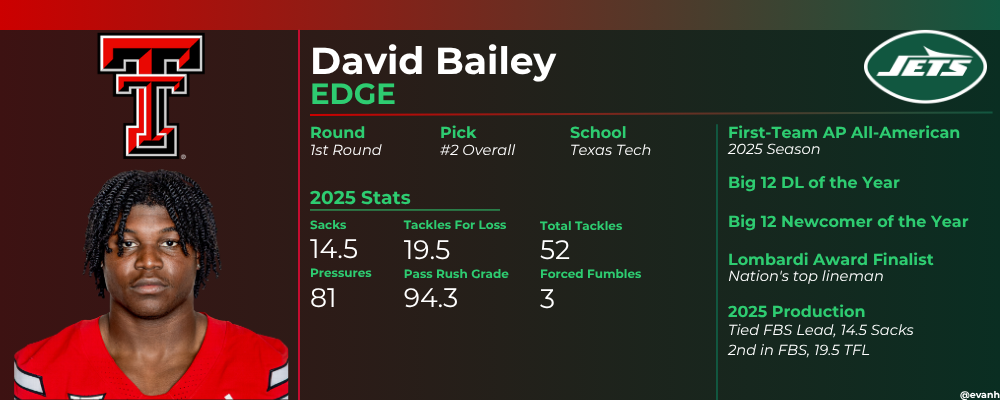
David Bailey led the entire FBS with 14.5 sacks (tied with Western Michigan's Nadame Tucker) and 19.5 tackles for loss last year, and the Jets took him over Ohio State's Arvell Reese because they wanted the proven floor over. First-Team AP All-American, Big 12 Defensive Lineman of the Year, Lombardi Award finalist. PFF graded him 92.4 overall, 5th among 852 qualified edges nationally, and his 73 total pressures led the country. He has a high motor and length, not just get-off. Defensive line coach Karl Dunbar already set the tone with him in camp:
“We’re teaching him how to play the run because you’ve got to earn the right to rush the passer. If you don’t stop the run, they’re not going to throw the ball”
That's exactly the right way to develop a high-upside edge rusher. By forcing him to earn it. And once he does, this is a player with legitimate get-off and pass-rush skills. Bailey has shown he can win with power at the point of attack and finish plays other rushers give up on. There will be a learning curve against NFL tackles who are faster and stronger than anything he saw in the Big 12, but the traits are real, and this is a No. 2 overall pick the Jets are going to lean on immediately.
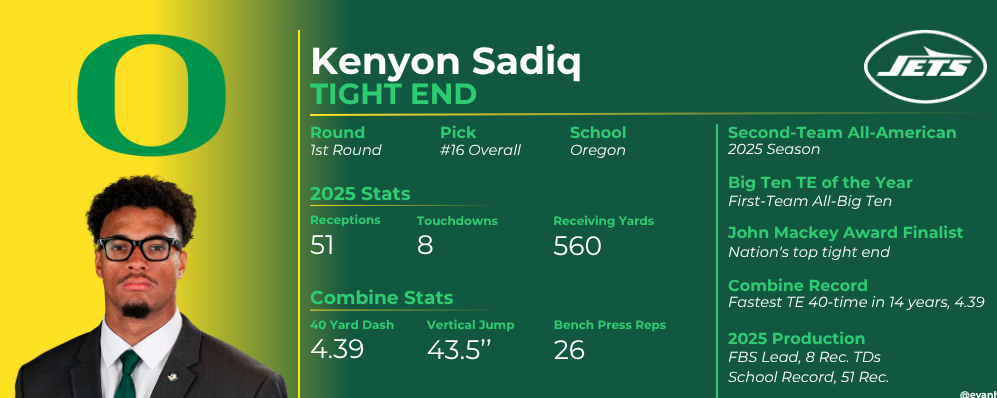
Kenyon Sadiq came over via the Sauce Gardner first-rounder. Saqiq set the tone at Oregon: Second-Team All-American, the first player in school history to win the Big Ten's Kwalick-Clark Tight End of the Year award, a unanimous First-Team All-Big Ten selection, and a John Mackey Award finalist. He caught 42 passes for 509 yards and led every tight end in the FBS with 8 touchdowns. Quarterbacks posted a 145.5 rating throwing his way, 6th among all qualified tight ends nationally. He wasn't just a red-zone specialist either, hauling in 7 of 12 contested catch opportunities and lining up in the slot on more than half his snaps, the kind of usage that shows real route versatility rather than a big body who only wins on size. At the combine, he ran the fastest 40 for a tight end in 14 years, 4.39 seconds, to go with a 43.5-inch vertical. He's too quick for linebackers and too physical for slot corners. Paired with Mason Taylor, this room gives the offense a real matchup advantage, and I expect Reich to get creative with how he deploys him this season.
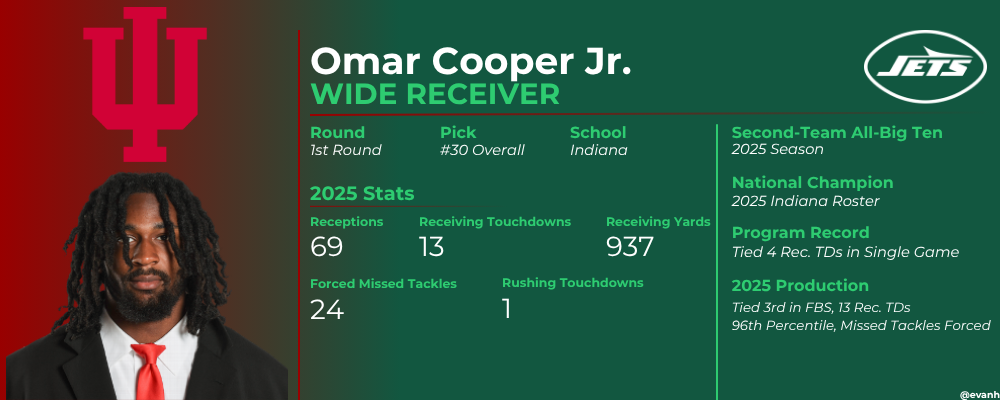
Omar Cooper Jr. comes off Indiana's undefeated national championship season with that winning mentality already built in. He's not a burner who wins on separation alone. He's a YAC weapon who plays like a running back with the ball in his hands, forcing 27 missed tackles on just 69 receptions last year, a 39.1% rate that ranked top-5 among all FBS receivers. PFF graded him 87.8 overall, 12th among 679 qualified receivers, and quarterbacks posted a 145.2 rating targeting him. He even carried the ball three times for 74 yards and a touchdown. He is great at creating yards after the catch instead of relying on scheming to get him open, and that's exactly the kind of second option Garrett Wilson needs next to him. The Jets gave up a fifth-round comp pick to move up three spots and get him before the first round ended, and for the value they got back, it was a great move.
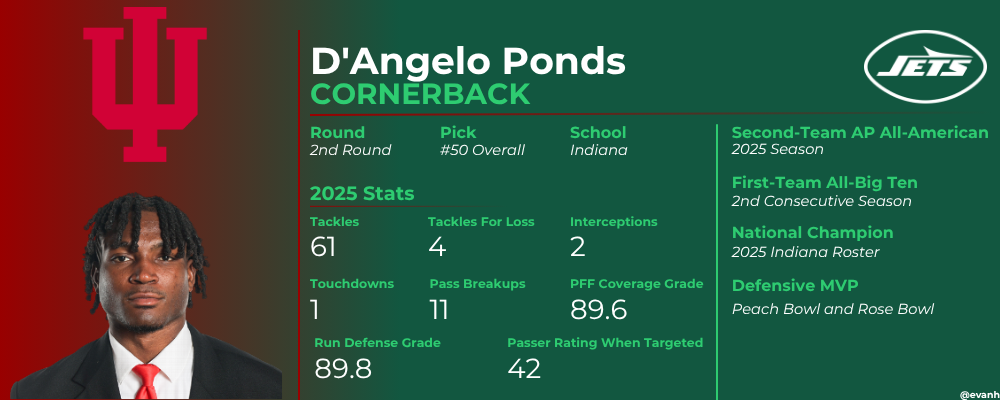
D'Angelo Ponds is undersized at 5-8 5/8, 182, with short arms to match at 29 3/8 inches, and that's the real knock on him. Everything else says first-round talent who fell because of a tape measure. PFF graded him 88.8 overall, 8th among 896 qualified corners nationally, with an 89.6 coverage grade that ranked 7th in the country. Quarterbacks posted just a 42.0 rating throwing at him all season. He skipped the 40 at the combine, however he didn't skip the vertical. 43.5 inches, the best mark among corners at that combine and one of the highest ever recorded at the position. He's sticky in man coverage, plays with instinctive route recognition, and understands what a receiver is trying to do before it happens. He projects to earn the starting slot role early, and he's coming from a program that just won a national title with a locker room full of guys who have an underdog winner mentality driven to win. That's a real value add for a secondary that's gone through a full revamp.
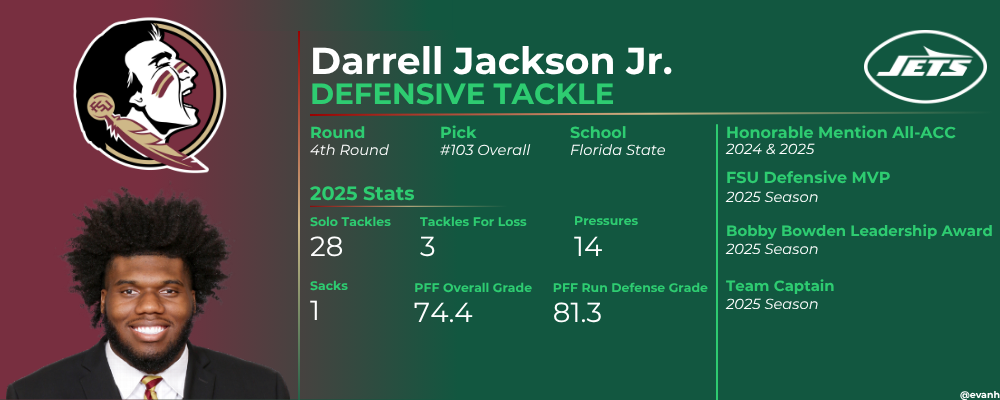
A developmental piece at 6-5, 337 who's shown flashes of game wrecking ability when his motor is right, but production inconsistency at Maryland, Miami, and FSU. There is no pressure for him to start day one as he is behind a crowded interior room, but this is what he needs to develop especially behind mentors such as Philips.
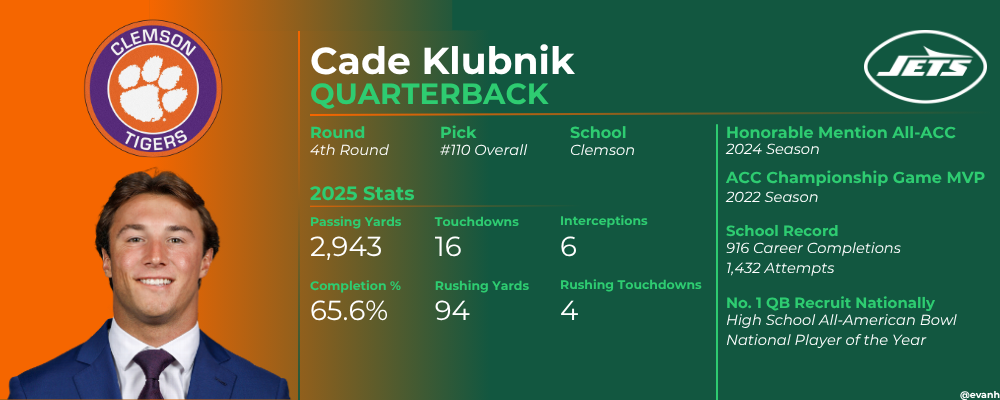
The Jets kept tabs on Cade Klubnik through his injury-shortened 7-6 season at Clemson, a season the rest of the league mostly wrote off. When they traded up in the fourth round to get him, it was because they had twelve months of evaluation everyone else skipped. The year-long tracking through his injury season is what got the Jets comfortable trading up for him here. Great value, high football character, and the plan is for him to sit and develop behind Geno while serving as the backup quarterback.
The Acquisitions
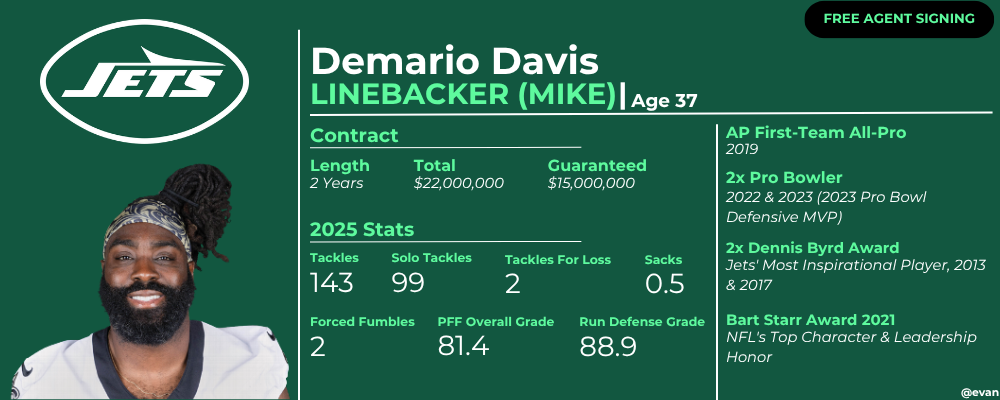
Demario Davis may be my favorite signing of the Jets offseason. Two years, $22M, $15M guaranteed, for a 37-year-old who's somehow still playing at a high level, 64 solo tackles and two forced fumbles last season with the Saints. What Davis brings to the organization goes beyond the field. This is a linebacker who reads offenses at a level most players his age have lost, commands the middle of the field, and has been through every kind of adversity a career can throw at a player. The mentorship and culture value here matters as much as the production. The Jets get a veteran presence who will improve a linebacker room that struggled last season, in a defense that needed leadership as much as it needed talent.
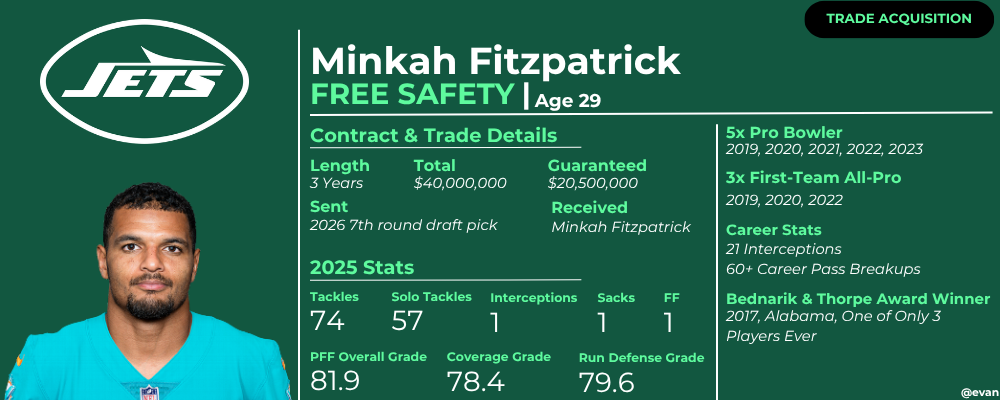
Minkah Fitzpatrick was acquired from Miami for a 2026 seventh-round pick. A three-time All-Pro safety for a seventh-round pick is incredible value. His restructured deal runs three years at $39.5M, climbing to $40M with per-game roster bonuses, and uses void years in 2029 and 2030 to keep his 2026 cap hit at just $7.41M. What makes Fitzpatrick different from most safeties is that he isn't a specialist. PFF graded him 81.9 overall last season, 7th among 98 qualified safeties, with strong marks in both coverage (78.4) and run defense (79.6). He's got more than 20 career interceptions, but the real value is his versatility. Minkah has played deep safety, slot corner, and a blitzer at a high level, often in the same season because his defense needed him everywhere. This addition in this secondary is exactly what the Jets needed. He locks down the room with talent, experience, and leadership.
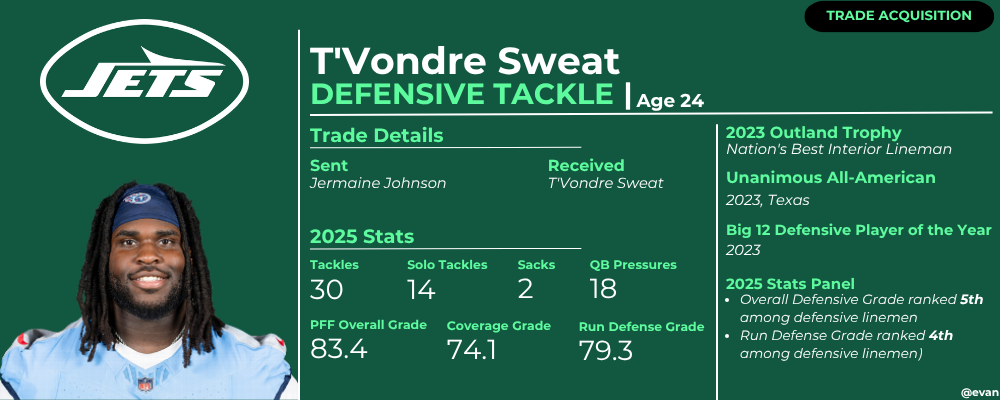
T'Vondre Sweat was acquired from Tennessee in the Jermaine Johnson player swap. He won the Outland Trophy and unanimous All-American honors at Texas in 2023, then logged the most defensive snaps of any rookie lineman in the 2024 draft class. PFF graded him 83.4 overall last season, 5th among 134 qualified interior linemen, with a 79.3 run-defense grade that ranked 4th at the position. He missed five games early in the season with an ankle injury, then came back and still generated 18 pressures and 21 solo tackles across 12 games. He will command double teams and open lanes for Bailey and McDonald to work one-on-one. Sweat is 24 and still on his rookie contract. What he unlocks for the edge rushers around him is the real value in this move, and is why Jets players and front office staff should be excited about it.
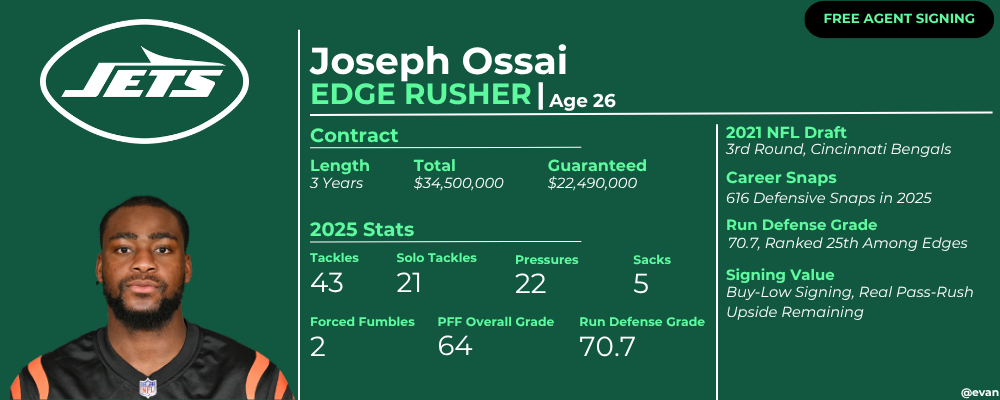
Three years, $36M, $22.5M guaranteed. At 25 he is one of the younger pieces added to this defense, and his deal is structured with a clean exit after year two if the production does not match the money. However the value he brings as a depth/rotational piece in this edge rusher room is valuable. He has to refine his skills but the upside is there and we should see an improved edge rusher room with the additions the Jets made this offseason.
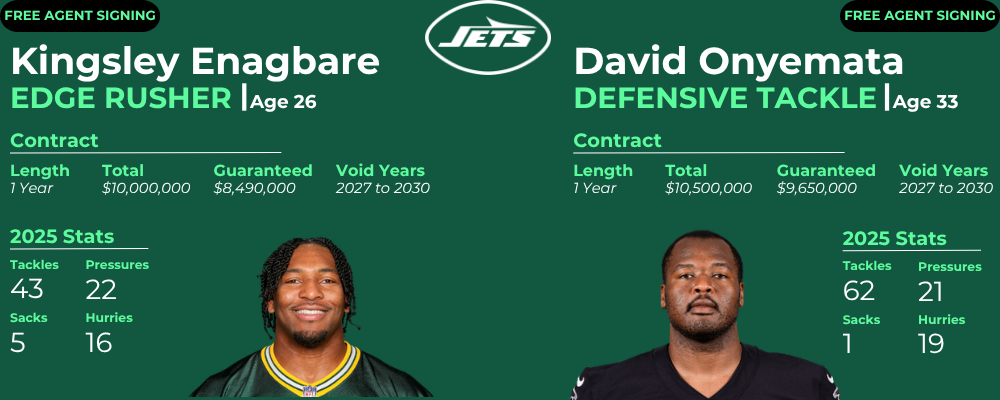
Kingsley Enagbare signed a one year, $10M, signed to upgrade the run defense rotation. He recorded 44 run stops over his last two seasons in Green Bay. This signing reflects the issues the Jets suffered last season against the run. He was brought in to do what he does best and stuff the run. This is a prove it deal where he will be expected to exceed against the run while showing pass rush upside.
David Onyemata signed a one year, $10.5M. At 33 he is not the long term answer, but he provides veteran snaps alongside Sweat and Phillips while Briggs and Jackson keep developing behind them. This is another signing that indicates the Jets were not happy with the result of their defense last year ranking nearly last and wanted to add proven players in this room who could stop the run.
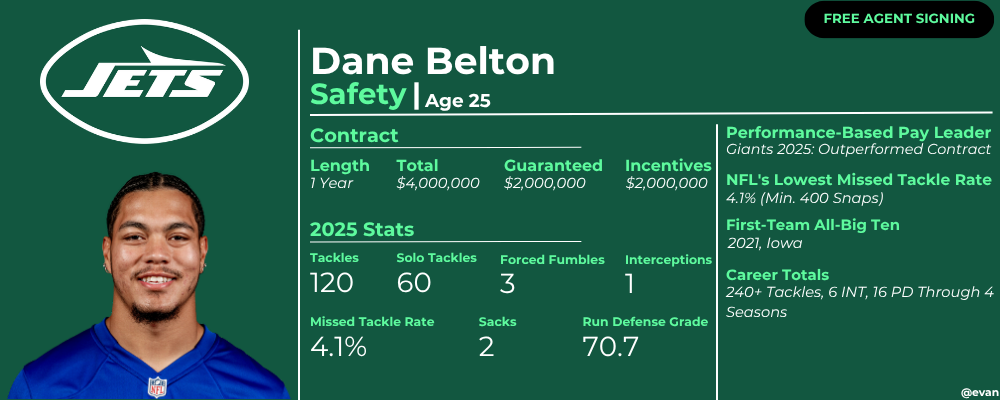
Dane Belton signed for one year, $4M, up to $6M with incentives, off a 2025 season with the Giants where he led the entire roster in Performance-Based Pay and posted the lowest missed tackle rate among all safeties with at least 400 defensive snaps in the league. He plays with the physicality of a converted linebacker, which he effectively was before the NFL, and his background as a wide receiver shows up in the way he tracks and finishes plays through the catch point. This is a low-cost, high-upside signing that gives this secondary a reliable rotational piece with starting potential if the situation calls for it.
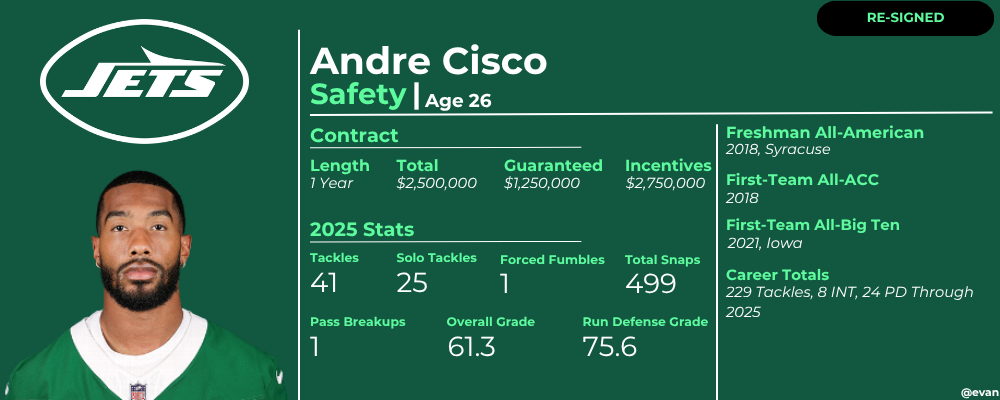
One year, low risk resigning coming off a season ending pectoral injury. He is a high upside, low cost, singing and he is in competition with Malachi Moore and Dane Belton for snaps at safety.
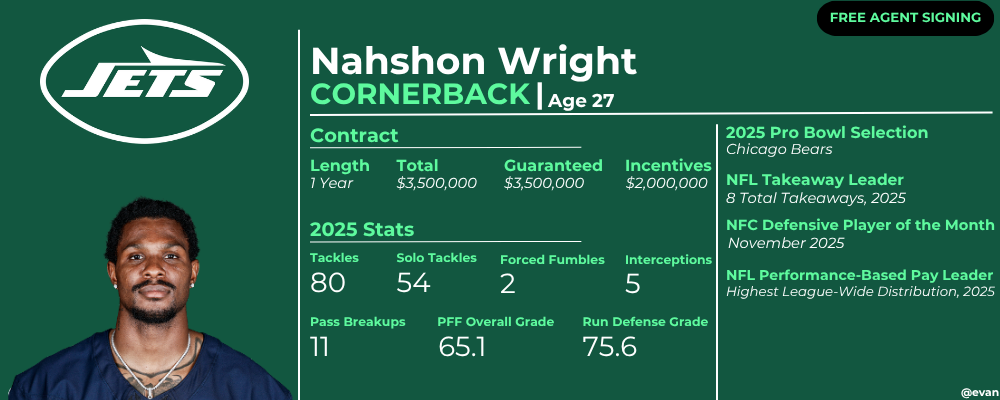
One year, $3.5M. Nahshon Wright coming off a strong 2025 season with the Bears only signed a One year $3.5 Million deal. He tied for the league lead in interceptions. He led the entire NFL in total takeaways with eight. He made the Pro Bowl. He won NFC Defensive Player of the Month. And he led the entire league in Performance-Based Pay, the NFL's own metric for outperforming your contract. The market still gave him a one-year, $3.5M deal because of a minor injury history and a lack of consistent production in prior seasons. The Jets took that bet without hesitation. If he plays anywhere near his 2025 level, this is one of the most valuable signings, especially since the Jets are slim in the cornerback room.
The Defense
Aaron Glenn built Detroit's unit into one of the league's best by running a multiple-front scheme that adapts to personnel rather than forcing a system on players. The base is a 4-3, but they shift freely into 3-4 looks and odd-front structures on early downs, and they live in nickel packages the majority of the time. The point of this is to win the line of scrimmage first, take away the run, and force teams into one-dimensional passing situations.
T'Vondre Sweat and Harrison Phillips anchor the interior up front. With Sweat as the centerpiece, a 24-year-old nose tackle still on his rookie deal who eats double teams and generated 18 pressures in just 12 games last season after an early-year ankle injury. Phillips brings the veteran experience and locker-room credibility. And then there is Jowon Briggs.
Jowon Briggs is one of the most underrated players on this entire roster. From Weeks 10 through 18 last season, after stepping directly into the role vacated by Quinnen Williams mid-trade, he ranked second among all interior defensive linemen in PFF pass rush grade at 89.4. Right there with Chris Jones. On a seventh-round pick salary. The contract situation around that production makes it even more interesting, he is on an exclusive rights tender right now, meaning the Jets have complete control of his rights without negotiating against the open market, and he will be a restricted free agent in 2027, still locked to this team. If that second-half level holds over a full season, Mougey is sitting on the best value asset in the building.
David Bailey and Will McDonald will hold down the edge spots, with Ossai and Enagbare rotating behind them. Bailey's job in year one is straightforward, earning the right to rush the passer by first proving he can hold up against the run. Karl Dunbar, defensive line coach, made that expectation clear in camp. McDonald is the more complicated conversation. Eight sacks last year is good production, but his run defense has been a real problem, one of the worst marks at his position by PFF's own numbers. This is a storyline to watch closely. He needs to show consistency and a strong or developing run defense in order to be awarded a new contract.
Demario Davis anchors the linebacker room at MIKE, which lets Jamien Sherwood slide back to his natural WILL spot after a rather disappointing 2025 season. Sherwood has a contract to justify, he is tied for the fifth highest cap number among all linebackers, and his pass coverage was a real liability, allowing a 125.1 passer rating when targeted. But Aaron Glenn has publicly noted Sherwood's self critical approach this offseason, and camp reports already point to improvement in his coverage reps. Francisco Mauigoa is pushing hard for snaps in what is expected to be a heavy two-linebacker scheme, and the reports out of this offseason suggest he is earning that third linebacker spot.
Nahshon Wright and Brandon Stephens are expected to hold down the boundary. Wright is coming off a Pro Bowl season and leads this room in terms of recent production and experience. Stephens is the more physical presence, a press-man corner who still has room to grow in coverage but brings strong run-support value on the boundary. Competing for the cornerback 2 spot sits Azareye'h Thomas, a 6-2 second-year corner with a 78-inch wingspan. Thomas is one of my breakout picks this year. D'Angelo Ponds is expected to start at the slot, a natural fit given his elite coverage grade and the instinctive playmaking ability that made him a steal in the second round. Jarvis Brownlee Jr. gives this room legitimate competition and depth at nickel as well. And behind them at Safety, Fitzpatrick, Cisco, Belton, and Moore give this safety room the kind of genuine depth it has not had in years, four different guys who can each carve out real roles depending on how the season develops.
The Offense
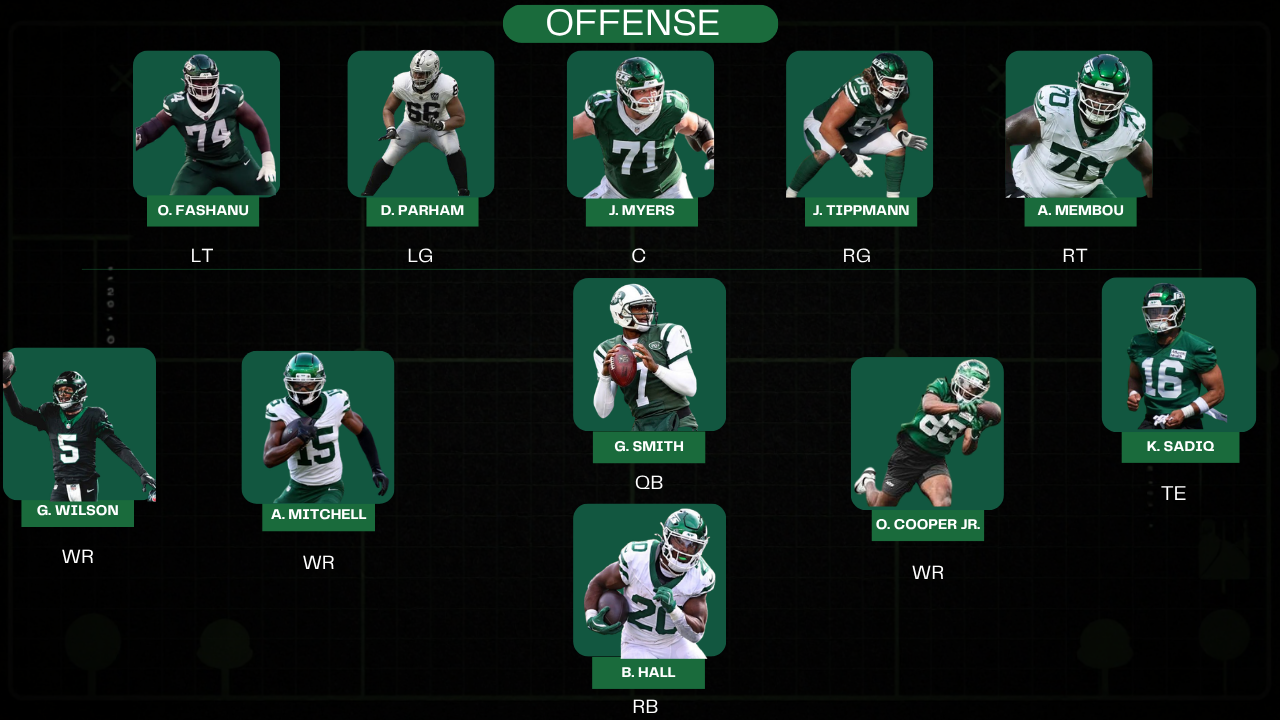
This offensive line is the strongest unit on this roster. Olu Fashanu enters year three at left tackle off a 74.5 pass blocking grade, a jump from his rookie 59.4, and he held a top five pass blocking grade league wide from Week 8 on. Armand Membou had an amazing rookie season at right tackle. Joe Tippmann just signed a four year extension worth up to $66.4M with $34.9M guaranteed and shifted to guard full time. Dylan Parham at left guard signed on a favorable two year deal. Josh Myers holds down center with lower grades but enough stability to let the talent around him carry the room.
Frank Reich builds offenses around creating mismatches, and this Jets roster gives him personnel he has rarely had access to before. His system attacks the full field, layering quick underneath triangle reads with vertical routes to pull safeties out of position and isolate defenders, and for most of his career that has meant heavy 11 personnel. But the Jets spent a first-round pick on Kenyon Sadiq specifically to pair him with Mason Taylor, which means they have a vision on how they will run this offense. Running both tight ends together forces a defensive coordinator into a decision he does not want to make before the ball is even snapped. Stay in base personnel and you are handing a linebacker a coverage assignment against Sadiq on a seam route, a matchup the defense is not going to win. Slide to nickel to handle that speed and you just took a body out of the box against Breece Hall. There is no clean answer on either side, and that is before Wilson, Mitchell, and Cooper are even factored into the equation. This is what smart personnel-driven roster construction actually looks like.
At the skill positions, the real story is how many different ways this offense can hurt a defense now. Last year, when injuries hit and Garrett Wilson was out, the offense looked lost. Now the offense is projected to have Adonai Mitchell, Omar Cooper Jr., Kenyon Sadiq, Mason Taylor, Breece Hall, and Braelon Allen all creating conflict. A defense cannot put two extra bodies on Wilson anymore without giving something else up. Adonai Mitchell gets his own breakdown below, but this room around him is why I think this year he takes off.
Breece Hall just signed an extension worth up to $45.75M, making him one of the highest-paid running backs in football, behind only Barkley, McCaffrey, Achane, and Derrick Henry. He surpassed 1,000 rushing yards last season with an offensive that had legitimate continuity issues, and that was without Braelon Allen alongside him for the majority of the year. Hall at his best is a weapon in every phase, as a runner, a receiver out of the backfield, and a mismatch problem in open space. Allen coming back healthy off that MCL tear adds a dimension to this backfield that was genuinely missing last season, a between-the-tackles power complement that takes pressure off Hall in short-yardage and goal-line situations.
The Central Question: What Is Geno Smith's Ceiling Here
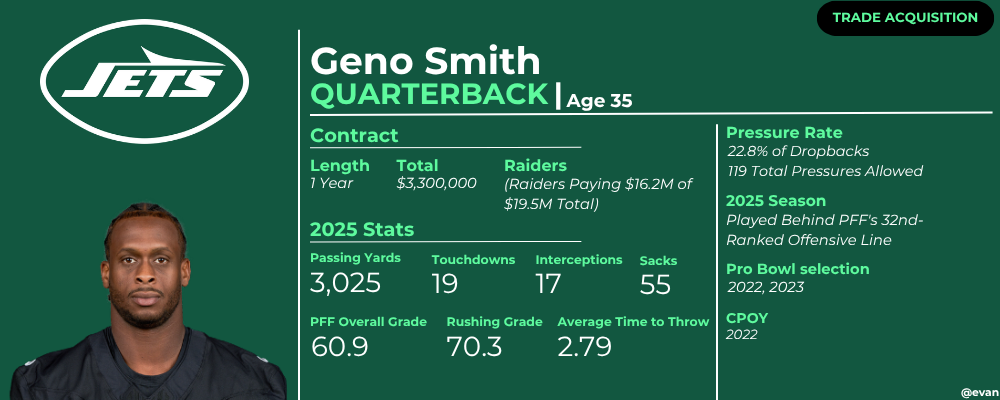
This is the section that decides how this whole season gets evaluated. Geno Smith came over from Las Vegas in a trade where the Raiders absorbed the bulk of his salary, $16.2 million of his $19.5 million total 2026 compensation, leaving the Jets paying barely over the league minimum for a quarterback who started 15 games for an NFL team last season. The cost of this move was a 2026 sixth-round pick. That is close to a free asset at the most important position on the field.
The raw 2025 numbers look rough on the surface: 3,025 yards, 19 touchdowns, 17 interceptions, an 84.7 passer rating, and a 60.9 PFF grade that ranked 36th of 43 qualified quarterbacks. However the situation behind those numbers matters more than the numbers themselves. He played behind PFF's 32nd-ranked offensive line in football, absorbed 119 total pressures across the season, and lost two starting linemen to injured reserve. And taking a closer look at the interception total it isn't as bad as narratives suggest. PFF's own model flags a real chunk of those 17 picks as outside his control, tipped passes, deflections, and a conversion rate on his risky throws well above the league average rate at which those plays actually become interceptions. Strip that variance out and his real number last year looks a lot closer to 12 or 13, not 17. That gap between just purely stats and the actual tape is an argument for why last season tells you almost nothing about what type of player the Jets got right now.
Now on the Jets he is on a team with an offensive line in front of him now that includes a top-five pass-blocking tackle in Olu Fashanu, a historically good rookie season from Armand Membou, and a freshly extended Joe Tippmann. Then you look at the weapons surrounding him and it is nothing close to what he had to deal with in Las Vegas. What decides this season is whether the offensive line protects him, whether these weapons translate into real efficiency within Reich's system, and whether his experience and command of the game show up the way it has at his best. Cade Klubnik sits behind him as the developmental answer if Geno's bridge tenure ends naturally or if he gets benched later in the season, not as a threat to the job right now.The Cap Picture
The Cap Picture
The Jets entered the 2026 league year with the fourth most cap space in football. Official cap for the year landed at $301.2M, and after the Breece Hall franchise tag, free agency, and the full rookie class signing, Over The Cap had the team down to roughly $27.4M in remaining space by mid June.
| Dead Cap Source | 2026 Hit | Origin |
| Aaron Rodgers | $35.0M | Post-June 1 release, 2025 |
| Justin Fields | $20.0M | Trade to Kansas City, March 2026 |
| Sauce Gardner | $11.0M | Trade deadline, Nov. 2025 |
| Quinnen Williams | $9.8M | Trade deadline, Nov. 2025 |
| C.J. Mosley | $7.65M | Restructure amortization |
| Michael Carter II | $6.8M | Restructure amortization |
| Quincy Williams | $4.875M | Void year trigger |
| John Simpson | $4.35M | Void year trigger |
| Allen Lazard | $4.37M | Restructure amortization |
| Andre Cisco | $4.0M | Void year trigger |
| Tyrod Taylor | $2.4M | Prior backup contract |
Expiring Contracts After 2026: Re-Sign or Move On
Geno Smith, QB — Move on unless he proves he can command this offense. If he does, a one year bridge extension in a more realistic $14-22M range makes sense to protect the rookie quarterback plan. If the offense struggles, let him walk as a free agent into 2027.
Harrison Phillips, DT — Re-sign at a cheaper number. This is a tough decision because it seems this defensive interior room has the depth and the upside to thrive however the value Harrison Philips brings is not just the production on the field. He is a great veteran presence in that locker room, and he has earned the chance to finish his career here. The flag is the room getting crowded, if Briggs, Jackson, and Sweat keep developing the way they should, Phillips could get squeezed out regardless of how well he plays.
Kingsley Enagbare, EDGE — Let him walk. This was a great one-year value signing on both sides. He will look for a multi-year deal if he performs well, and the Jets should let him find it elsewhere. With three first-round picks and flexibility with cap space heading into 2027, there will be better options at a higher ceiling.
David Onyemata, DT — Move on at 33. If the front office is only keeping one older defensive tackle in this room, it should be Phillips. This room is crowded already and there is no need to keep him.
Dane Belton, S — This depends entirely on what kind of season he has. If he proves he can be a core contributor or a starter, he is in line for a deal in the range of what Grant Delpit, Justin Reid, or Brandon Jones command. If he shows he is better suited to a rotational role, the contract should reflect that instead. So if he shows value and is a contributor in changing the culture and narrative surrounding this Jets defense the Jets front office should strongly consider bringing him back especially the value he brings as a multi role player in the secondary.
Nahshon Wright, CB — If Wright plays anywhere near his 2025 level, the Jets should strongly consider bringing him back. The 2027 corner class is deep and they have the draft capital to find a long-term answer there, so overpaying to retain him is not the move. But a reasonable second year deal for a player who just made the Pro Bowl on a minimum contract is worth serious consideration.
Andre Cisco, S — If he proves he is fully past the pectoral injury and shows he can be a consistent, reliable safety, re-sign him at two years, $19M. If Dane Belton proves he can step up and Malachi Moore shows real development, let Cisco walk in free agency instead.
Breakout Candidates
Adonai Mitchell
Adonai Mitchell. We have only seen flashes of what this offense is going to ask him to do, and that is the whole point. He has the size, the catch radius, and the deep speed to be a legitimate second outlet opposite Garrett Wilson, and last year he never got the structure or the surrounding talent to show it consistently. Selected 52nd overall in the 2024 draft out of Texas, he ran a 4.34 forty at that combine — great X-receiver speed and route-running ability that has not yet been allowed to show up on tape. In his short career he has already lived through the extremes of this league: getting drafted by the Colts, getting traded, learning multiple new playbooks in consecutive offseasons. This is the first time he's had a real offseason and a real training camp to build chemistry inside one system.
With Wilson, Cooper, Hall, Sadiq, and Taylor all drawing attention elsewhere on this offense, defenses cannot afford to put a second body on Mitchell the way they could last season. He has not come close to his full development yet, and is the year I believe he shocks the league.
Azareye'h Thomas.
21-year-old, 6-foot-1 corner with a 78-inch wingspan and genuinely impressive press coverage instincts, exactly the kind of difference-maker a cornerback room that went through this much turnover needs. Entering his second season, he has a real path to a starting role, and a full offseason of experience and a better feel for the speed of the NFL puts him on track for a real jump. He has already turned heads in OTAs and mandatory minicamp going head to head with Nahshon Wright for the CB2 job, and whoever ends up on the losing side of that competition should still see real opportunity once the season starts.
Jowon Briggs
Already covered in detail above, but worth restating here, a near All-Pro level pass rush grade over the final nine games of last season on a seventh-round pick price tag. A full healthy offseason in this scheme is the only thing standing between him and a legitimate breakout campaign.
Braelon Allen
Heading into year three, if he comes back fully healthy off that MCL tear, he is the power complement this backfield has been missing behind Breece Hall. He has the size, the traits, and the potential to be a true difference-maker at the position, but injuries have repeatedly interrupted his development. Aaron Glenn has already been honest about how much the team's plans last year hinged on him: "That was the vision, with Braelon Allen, Breece Hall, and Isaiah Davis last year, and obviously that didn't come to fruition." . Glenn has been genuinely excited to have Allen back and healthy this offseason, and he has looked explosive in OTAs. Having him in the mix does more than add a complementary back, it lets Breece Hall operate at his best instead of carrying the entire load himself.
Armand Membou
This is less a breakout and more a continuation, since he already graded as one of the best rookie tackles in the league. His first career start came against T.J. Watt, and Watt was held without a sack that game. Membou went on to play all 17 games as a rookie, and after his first six contests he did not draw a single holding penalty the rest of the season. Center Josh Myers has already made clear what the ceiling looks like and continues to praise the player Armand Membou is and who he can be.
Another real step forward this year puts him squarely in the conversation as a top-ten right tackle in the league, not just a great young one. He could become a cornerstone of this offense if he keeps trending this way
Francisco "Kiko" Mauigoa
There has been real speculation about whether the Jets need to add another linebacker to this room. They should not. Mauigoa, a 2025 fifth-round pick, has shown legitimate upside and is reportedly having a strong camp, putting himself directly in position to win the third linebacker job over Marcelino McCrary-Ball and Mykal Walker. He struggled in pass coverage as a rookie, but multiple reports out of OTAs and minicamp point to real progress there, multiple pass breakups in coverage, better reads on the offense, and improved instincts against the run. Camp performance does not guarantee anything once the season starts, but if this is a real indicator of a player who developed in year two, he could be on his way to locking down that role outright.
Dane Belton
Belton played wide receiver in high school and a hybrid linebacker in-the-box safety background that shows up clearly on tape now. He plays his best football in short zone coverage and matched up against tight ends, and that receiver background helps him track the ball and finish plays through the catch point. His missed tackle rate was the lowest among all NFL safeties with at least 400 defensive snaps last season, and he plays with the kind of relentless effort and physicality you would expect from a converted linebacker, willing to take on blockers and finish through contact rather than around it. He brings real instincts for reading and anticipating blocks before they develop. This is exactly the kind of low-cost, high-upside addition that pays off in two ways, a trustworthy rotational piece if a starter goes down, and a real candidate to break out and start outright if his level holds. In his own words: "I make plays on the ball. That's kind of my signature, getting the ball and being able to do that for this team will be huge. And just have fun and play good football."
Trade and Cut Candidates
| Player | Pos | Age | Action | Cap Savings | Destinations | Key Reasoning |
| Mazi Smith | DT | 24 | Trade | +$2.56M (trade) / $0 (cut) | Giants, Jaguars, Falcons | Defensive interior room is too crowded behind Briggs, Sweat, Onyemata, and Jackson, and the fully guaranteed base salary means a trade is the only version of this that actually saves any money |
| Brady Cook | QB | 24 | Cut | +$840K, but offset by next man up under Top 51 rule | N/A | Four quarterbacks doesn't work heading into the 2026 season, this is most likely a cut rather than a trade since he isn't a starter anywhere else in the league |
| Braiden McGregor | EDGE | 24 | Cut | +$1.08M, but offset by next man up under Top 51 rule | N/A | With real additions made in free agency and the draft, the Jets likely want edge depth that offers more upside in the rotation rather than retaining him purely for roster familiarity |
| Will McDonald IV | EDGE | 25 | Trade | +$762.7K (pre-6/1) or deferred to 2027 | Browns, 49ers, Packers | Demand for edge rushers is high right now, especially with Micah Parsons potentially out into midseason, and if his run defense inconsistency continues the Jets should consider moving him for a 3rd round pick, his exercised 5th year option should still generate real interest |
| Jamaal Pritchett | WR/KR/PR | 25 | Cut | +$840K, but offset by next man up under Top 51 rule | N/A | Zero dead cap risk if cut, and the Jets already have established return depth on the roster |
| Dean Clark | S | 24 | Cut | +$960K, but offset by next man up under Top 51 rule | N/A | Original UDFA guarantee already fully paid out, no signing bonus to accelerate, squeezed out by a deep safety room |
Mazi Smith is the one name on this list where the financial mechanics actually dictate the decision rather than just supporting it. Because the Jets acquired him from Dallas at the trade deadline, the entire $6.65 million signing bonus from his original rookie deal stayed on the Cowboys' books, the Jets only ever inherited his base salary. That salary is fully guaranteed in 2026, which means cutting him saves the Jets nothing, his full $2.56 million cap hit just shifts over to dead money with zero relief. A trade is the only version of moving on that actually clears space, wiping the full $2.56 million off the books since the acquiring team takes on that guaranteed base. The driver here is that this room is crowded. The interior is stacked behind Briggs, Sweat, Onyemata, and Jackson, and with the fifth year option already declined, I'd expect interest from teams like the Giants, Jaguars, or Falcons, all of whom could use rotational interior depth. I'd project the return somewhere around a sixth or seventh round pick, or the Jets attaching a seventh themselves to move up into the back half of the fifth round.
Brady Cook has zero leverage on this roster. Four quarterbacks doesn't work heading into the 2026 season, and is most likely a cut rather than a trade, since he isn't a starter anywhere else in the league and there's no real market to send him to. Whether the Jets cut or shop him the financial outcome is identical either way, no signing bonus means no dead cap acceleration on this one.
Braiden McGregor is the clear cut candidate of the group. He's on a UDFA deal with no remaining guarantees, and with the Jets adding talent in Bailey, Ossai, and Enagbare on top of McDonald and Tyler Baron, this front office now has the luxury of choosing rotational edge depth with more upside than retaining him purely on familiarity. There's no path to snaps here regardless of what he shows in camp.
Will McDonald IV is the biggest name on this list. Since we're past the June 1 deadline for this league year, any trade now falls under post-June 1 rules, meaning the Jets would only absorb his 2026 proration as dead money rather than accelerating the 2027 hit too, a cleaner exit than trading him earlier this offseason would have been. The acquiring team still inherits his fully guaranteed base salary and his already-exercised fifth year option. The demand for edge rushers around the league is high right now. Teams like the Browns, 49ers, or Packers (especially with Micah Parsons potentially out into midseason) could all have interest in a player with his pedigree and an already-exercised fifth year option. If the run defense inconsistency continues the Jets could look to make a move. I'd expect the Jets to be able to land a third round pick in this kind of market.
Jamaal Pritchett and Dean Clark round this out as pure roster bubble decisions. Both carry zero dead cap because neither has a signing bonus to accelerate, and both get replaced under the Top 51 rule by a near-identical minimum contract the moment they are gone. Pritchett lost the slot competition to Xavier Gipson, and Clark is fighting just to keep a spot in front of VJ Payne in a deep safety room.
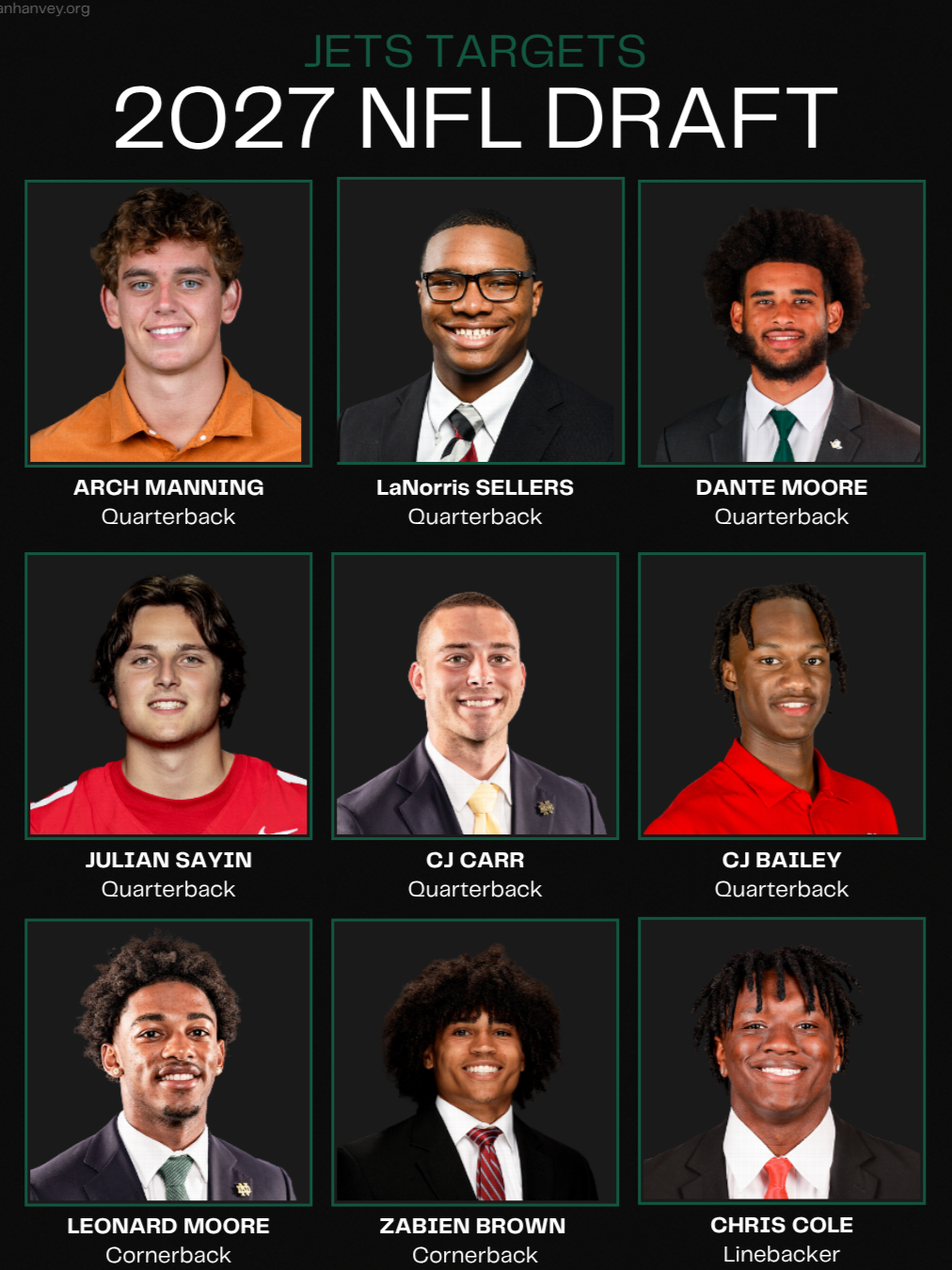
The Jets project to hold roughly ten total selections in 2027, headlined by three first-round picks: their own, the Colts' selection from the Sauce Gardner trade, and the better of Dallas's or Green Bay's pick from the Quinnen Williams trade. That combination of capital heading into what could be one of the deepest draft classes in recent memory is the real payoff for everything this front office absorbed over the last two seasons.
The quarterback class is where the Jets should be locked in. Arch Manning is the consensus centerpiece, a pocket processor with elite pedigree and arm talent who looked more comfortable towards the end of the season at Texas. Dante Moore at Oregon has the arm talent, anticipation, and great ball placement. CJ Carr at Notre Dame is smooth and athletic, a high-floor passer with legitimate starter traits. LaNorris Sellers is the riser to watch this season, dual-threat speed and arm that could push him into the first round conversation if he performs. Julian Sayin and CJ Bailey round out a quarterback class that could legitimately produce five or six first-round players. The Jets should be locked onto this group from day one of the college football season.
The edge class is just as appealing. Colin Simmons at Texas is the most complete edge rusher in the group, a bend-and-burst rusher who posted 59 pressures and ten sacks last season and wins reps consistently, he is a potential top-five pick unless they are holding multiple top-ten selections. Dylan Stewart at South Carolina is another top talent. Stewart generated 37 pressures and five sacks as a sophomore, and brings 77 inches of length with genuine bend and burst off the edge. This upcoming season will define where he lands but the ceiling is among the highest in the class. Matayo Uiagalelei at Oregon is another name the Jets should be monitoring. He posted 52 pressures and six sacks across 726 snaps, wins with heavy long arms and has a deep arsenal of counters rather than just pure burst.
The linebacker class deserves attention too. Chris Cole at Georgia is the name the Jets should be focused on closely. He is a coverage-first hybrid linebacker, a former five-star with rare speed who can carry seams, match in space, and line up off the ball, in the slot, and on the edge. He brings the kind of modern three-down versatility that NFL defenses are prioritizing against spread offenses. Kyngstonn Viliamu-Asa at Notre Dame is the other name to know here. A do-everything linebacker whose run defense sat at the very top of the position last season, he brings downhill force, alignment flexibility, and genuine range as a chess piece. However he suffered a season-ending knee injury last November, but when healthy the tape backs a top linebacker in this class. Having Demario Davis as a mentor to either of these linebackers is incredibly valuable as well.
The cornerback class rounds out what could be an all-time draft for this organization. Leonard Moore at Notre Dame is the best cover corner in this class right now, a true sophomore whose man coverage graded at the very top of the position with five interceptions and seven breakups in ten games. He mirrors routes in press, recovers when beaten, and reads the quarterback in zone. The combination of fluid hips, recovery speed, and length is what you build a secondary around. While his tackling needs work, seven misses and inconsistent run support in the open field, he has this season to show improvement, regardless he is a true shutdown corner. Zabien Brown at Alabama is a sticky man-cover corner who pairs timed speed with strong run defense. Two pick-sixes, including a 99-yarder, reliable tackling at only five misses across 764 snaps, and the speed-and-toughness combination of a first-round prospect. Both are legitimate first-round corners who would be immediate starters to this roster and could be available when the Jets are on the clock.
The point of listing all of this is not to say the Jets will or should take any of the players listed. The point is that holding three first-round picks heading into a class this deep at quarterback, edge, corner, and linebacker while not listing all the other position groups and players that will break out and rise to the top, gives this front office a rare set of options. They can solve the quarterback position, strengthen the defense in the trenches and secondary, or some combination of both. No other front office in the league goes into that draft weekend with this kind of flexibility. This Jets rebuild is at the perfect time because the needs they have could all be filled this 2027 NFL Draft.
Bottom Line: What a Successful Season Looks Like
A successful season for the Jets has nothing to do with wins and losses. It is whether you can look at this offense at the end of the year and say the pieces are there, that either Geno proved he is the long term answer or that whoever takes over at quarterback next, rookie or otherwise, is inheriting a situation no Jets quarterback has ever had. And it is whether this defense, even while there are holes, showed it can consistently stop the run, hold up in coverage, and develop the young pieces in that room. Hit both of those, and this rebuild is exactly on schedule no matter what the win total says.
