Miami's Historic Dead Cap Number Is Hiding the Real Plan
Mike McDaniel is gone. Chris Grier is gone. Tyreek Hill is gone, released February 16. Minkah Fitzpatrick is gone, traded to the Jets March 9. Bradley Chubb is gone, released March 11. Tua Tagovailoa is gone, released March 12 for a record-setting dead cap hit. Jaylen Waddle is gone, traded March 17 to Denver. And on top of all of that, the Dolphins are carrying $179.2 million in dead cap this season, more than 58 percent of a team salary cap that sits at roughly $308.5 million with carryover included, the largest dead money total in NFL history.
Every item on that list is real, and every one of them is why national media keeps calling this a tank year. Then look at who Miami actually extended in the middle of all of it, and the tank talk stops making sense.
New general manager Jon-Eric Sullivan and new head coach Jeff Hafley took over in January, 10 days apart, both coming straight out of the Green Bay organization. Sullivan spent 22 years there, the last three as vice president of player personnel. Hafley spent the two seasons before Miami running Green Bay's defense. People around the building have already started calling this staff "Green Bay South."
If they were really trying to tank, the sequence of moves would look completely different. Instead, Sullivan opened his tenure by signing quarterback Malik Willis to a below-market three-year deal and by turning the Waddle trade into three draft picks, a first, a third, and a fourth. Then, once free agency and the draft were both behind him, he spent the summer making it official with the players he actually wants to build around: De'Von Achane in May, Aaron Brewer in June, and Jordyn Brooks in July, all extended before a single snap of the 2026 season.
Here's what all of that actually looks like, position by position, dollar by dollar, and why the front office chose to take all of this pain in one single season instead of spreading it across four.
The Front Office
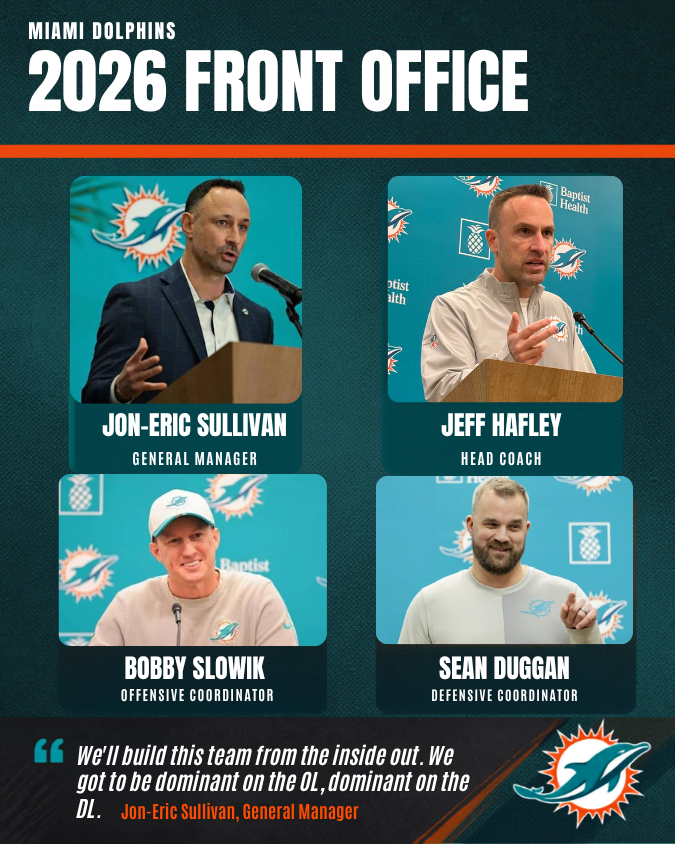
Sullivan's hire came first, on January 9. Hafley followed on January 19, signed to a five-year deal as the 12th head coach in franchise history. Both men spent the last several years in the same building in Green Bay, and it shows in how they talk about the job.
“Jeff is a man of integrity, intellect and great passion who players will buy into and play for. He has a vision for the kind of team we will be and the ability to motivate them to move in one direction on the path towards that goal.”
Hafley brings 26 years of coaching experience, 10 of them in the NFL, four as head coach at Boston College, and the two seasons immediately before this one running Green Bay's defense, where his unit finished 2024 fourth in the league in takeaways and fifth in total defense. He's been open about what the climb cost him.
“I wanted to have no regrets, and I wanted to give everything that I had because I had sacrificed a lot. I really didn’t go out. I didn’t do anything but coach football... I’m going to give everything I got for two years, and I want to see where this takes me.”
The rest of the staff was built around that same pipeline. Bobby Slowik, who joined Miami in 2025 as senior passing game coordinator, was promoted to offensive coordinator in February after running Houston's offense and developing C.J. Stroud as a rookie. Sean Duggan, at 33, is the youngest defensive coordinator in the NFL, and he's worked under Hafley since 2019 across three different stops. Chris Tabor, who ran special teams in Carolina, rounds out the staff.
Duggan has been blunt about how roles get decided in this building.
“Right now I view everything as a competition. It’s something Haf has preached about since the day he got here. Everything’s a competition. We’re going to play the best guys. It really doesn’t matter how long you’ve been here, when you were drafted; the best guys are going to play.”
That's the entire operating philosophy in one quote. Nobody's roster spot is secured. It has to be earned every single week, from the extended veterans down to the priority UDFAs.
The Extensions
De'Von Achane signed a four-year extension reportedly worth $64 to $68 million in May.
Aaron Brewer signed a three-year, $52.5 million extension in June.
Jordyn Brooks signed a three-year, $51.3 million extension in July, carrying $35 million guaranteed.
Sullivan waited until after free agency and the draft to make these official, which tells you exactly how sure he already was about who the core of this roster is going to be.
The Departures
The releases and trades that funded this roster reset, in order: Tyreek Hill, released February 16 ($28,248,750 in 2026 dead cap). Minkah Fitzpatrick, traded to the Jets on March 9. Bradley Chubb, released March 11 with a post-June 1 designation ($10,972,742 in 2026, $12,886,500 more in 2027). Tua Tagovailoa, released March 12, also post-June 1 ($55.4 million in 2026, $43.8 million more in 2027). James Daniels, Nick Westbrook-Ikhine, Liam Eichenberg, Alec Ingold, and Jason Sanders were all let go in the same stretch.
Miami sent Waddle to Denver on March 17, along with a 2026 fourth-round pick, in exchange for Denver's 2026 first, third, and fourth-round picks. Compare that to what the rest of the league's star receiver trades actually looked like this offseason. New England gave up a first and a fifth-round pick for A.J. Brown. Pittsburgh sent George Pickens to Dallas and only got a third and a fifth back in return, even after Pickens turned into a first-team All-Pro. Miami got a first, a third, and a fourth for Waddle while giving up only a fourth of its own. That's one of the best returns any team got for a receiver this entire offseason.
The Free Agency Additions
| Player | Pos | Terms | Guaranteed | Role |
|---|---|---|---|---|
| Malik Willis | QB | 3 yrs / $67.5M | $45.0M | Starting QB |
| Greg Dulcich | TE | 1 yr / $3.25M | $1.5M | TE1 |
| Joshua Uche | Edge | 1 yr | $1.075M | Edge rotation |
| David Ojabo | Edge | 1 yr, low-cost | Minimum-tier | Edge rotation |
| Tutu Atwell | WR | 1 yr / $1.4M | $1.075M | Slot depth |
| Jalen Tolbert | WR | 1 yr | $1.075M | WR depth |
| Jalen Reagor | WR | 1 yr, low-cost | Minimum-tier | WR depth |
| Darrell Baker Jr. | CB | 1 yr | $1.075M | CB competition |
| Marco Wilson | CB | 1 yr, low-cost | Minimum-tier | CB depth |
| Lonnie Johnson Jr. | S | 1 yr, low-cost | Minimum-tier | Safety depth |
| Zayne Anderson | S | 1 yr | $565K | Special teams / safety depth |
| Willie Gay Jr. | LB | Re-signed, 1 yr | $500K | LB depth |
| Riley Patterson | K | Re-signed | — | Kicker competition |
The Draft Class
| Rd (Pick) | Player | Pos | School |
|---|---|---|---|
| 1 (12) | Kadyn Proctor | OT/OG | Alabama |
| 1 (27) | Chris Johnson | CB | San Diego State |
| 2 (43) | Jacob Rodriguez | LB | Texas Tech |
| 3 (75) | Caleb Douglas | WR | Texas Tech |
| 3 (87) | Will Kacmarek | TE | Ohio State |
| 3 (94) | Chris Bell | WR | Louisville |
| 4 (130) | Trey Moore | Edge | Texas |
| 4 (138) | Kyle Louis | LB | Pittsburgh |
| 5 (151) | Michael Taaffe | S | Texas |
| 5 (177) | Seydou Traore | TE | Arkansas State |
| 5 (180) | Kevin Coleman Jr. | WR | Missouri |
| 6 | DJ Campbell | G | Texas |
| 7 (227) | Max Llewellyn | Edge | Iowa State |
| 7 (238) | Gottlieb Ayedze | OT | Maryland |
Thirteen picks, tying a franchise record, six of them inside the top 100. Every position group below gets into what each of these players actually looks like on tape and where they fit.
Quarterback: Malik Willis
Arguably the biggest storyline of Miami's entire offseason is the Malik Willis signing. Three years, $67.5 million, $45 million fully guaranteed. This deal is priced in the bottom third of the veteran quarterback market on AAV, total value, and guaranteed money, below the tier median across the board. His actual 2026 cap number is just $5.67 million despite the guarantee, with most of the money built into future seasons rather than paid as an immediate lump sum. If it doesn't, Miami's 2027 cap flexibility and an early first-round pick in a deep quarterback class cushion the fall. If it does, they got a franchise answer at a discount.
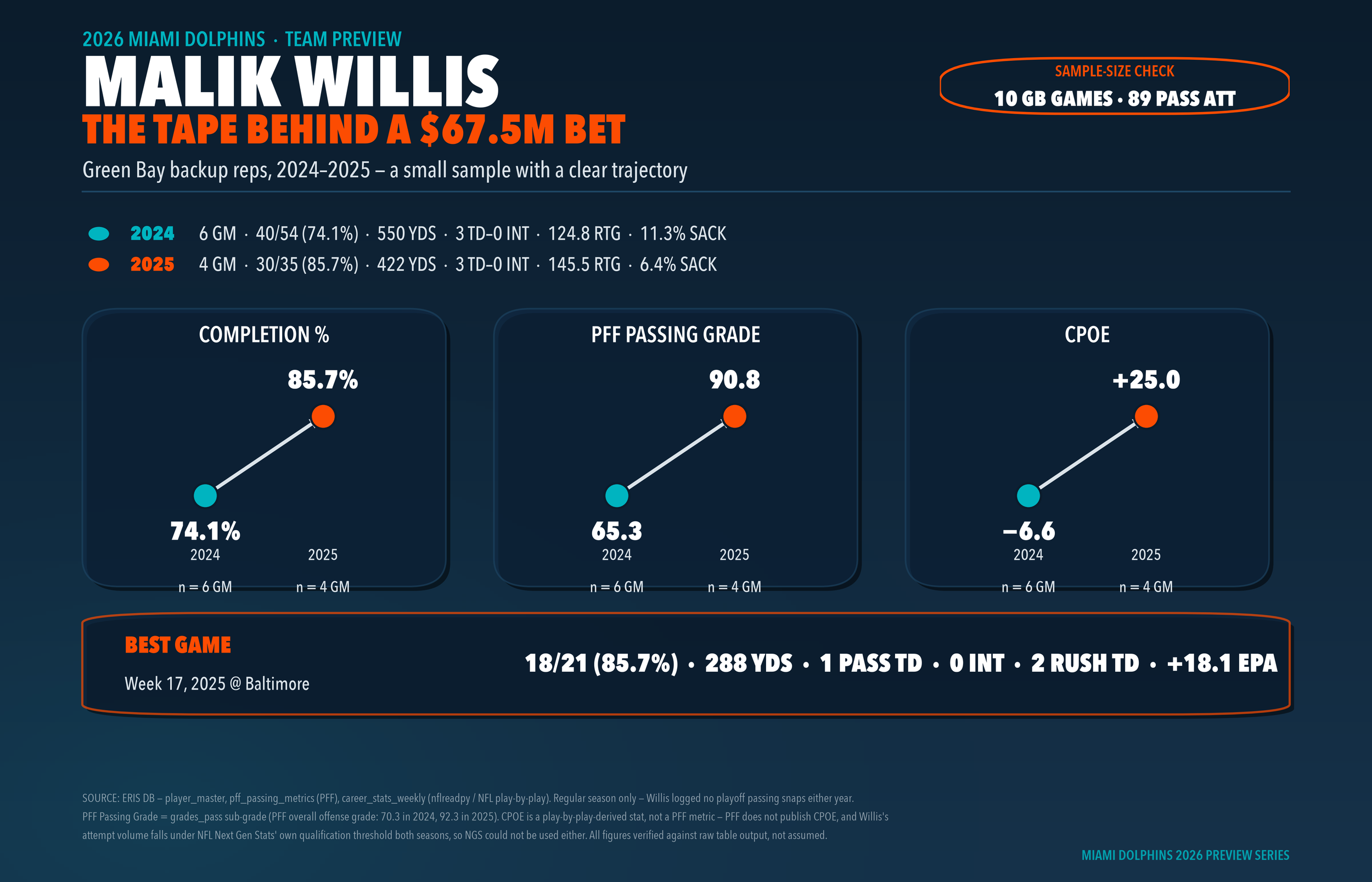
Willis spent four seasons in the league before this, first as a Titans third-round pick who never got put in a fair position to succeed, then as Jordan Love's backup in Green Bay, where he actually got to play behind an above-average offensive line inside a modern scheme for the first time in his career. The tape backs up why Miami bet on him. In six appearances for the Packers in 2024, he completed 40 of 54 passes for 550 yards and 3 touchdowns with zero interceptions. He was also sacked 8 times. In four appearances in 2025, he was sharper: 30 of 35 for 422 yards, 3 touchdowns, zero interceptions again, and a career-best 90.8 PFF passing grade. His completion percentage over expectation jumped from -6.6 in 2024 to +25.0 in 2025, one of the largest year-over-year jumps of any backup quarterback in the league. His best single game on file is Week 17 of last season against Baltimore: 18 of 21 for 288 yards and a touchdown, an 18.10 EPA per play mark that would rank near the top of the league over a full season. Zero interceptions across two full seasons on a limited sample says something meaningful about how carefully he protects the football.
The relationship with Hafley predates the contract by two full years. Hafley ran Green Bay's defense while Willis ran the scout team offense, which meant Willis spent two years giving Hafley's starting defense different quarterback looks in practice, day after day. That's two years of the two of them working closely together, building the kind of rapport that doesn't usually exist between a head coach and a free agent quarterback on day one.
Hafley has been just as direct about what he wants from Willis, which is basically nothing manufactured.
“I want Malik to be himself. There’s nothing I’m going to sit here and say that I want this, this, this and this. I want Malik to come in and be himself. I don’t want him to change on or off the field because he’s an incredible human, and I think he’s got great leadership qualities that guys will rally around... He needs to develop, he needs to continue to grow, but I’m not going to put any expectation on what I want to see from him.”
Slowik's system is built to help him. The offense is targeting close to a 50/50 run-pass split on early downs, using De'Von Achane and a physically massive offensive line to control the game before ever asking Willis to do too much on his own.
Willis has also talked about earning trust rather than assuming it, which tracks with everything Sullivan and Hafley have said about competition being the standard for every single roster spot in this building.
What could this actually look like on Sundays? A mobile quarterback who protects the football, spins it accurately, and has a legitimate top-five running back next to him in the backfield. If the offensive line holds up the way Brewer and Proctor think it can, this is an offense built to stay ahead of schedule and keep Willis out of obvious passing situations, leaning on the same mobility and improvisational ability that stood out about him in Green Bay.
Bottom Line: Willis doesn't need to put up MVP numbers, he just needs to maintain his Green Bay poise, protect the football, and prove he can command this offense, with a real chance to help lead this team to the playoffs if the roster continues to be built out the right way.
Quarterback Depth
Behind Willis, Quinn Ewers is expected to earn the QB2 job. He got meaningful run at the end of last season replacing Tua and looked comfortable enough that Hafley has praised his growth in the new scheme multiple times through OTAs and minicamp. Cam Miller, added off Las Vegas's practice squad in January, and undrafted rookie Mark Gronowski round out a room that's realistically carrying only two quarterbacks on the initial 53. If Willis goes down, Ewers is the answer, and this building already trusts him to start games if it comes to that.
Bottom Line: if Willis goes down, this staff already trusts Ewers to start games.
Running Backs
De'Von Achane is the best player on this roster. In 2025 he carried the ball 238 times for 1,350 yards, his first 1,300-yard season, while playing 75.4 percent of Miami's offensive snaps. He added 67 catches for 488 yards out of the backfield. His rookie-year efficiency on limited touches (a 145.7 elusive rating in 2023) was already special; last year he turned that talent into a full workhorse role. He's coming off a shoulder injury from late in the 2025 season that limited his offseason reps, and staying healthy is the only lingering question mark attached to him.
Achane has also talked about the chemistry he's building with Willis specifically, which matters given how much of this offense is designed to run through both of them together.
Behind him, Jaylen Wright is still looking for his place in this offense. He's shown burst (68 carries for 249 yards in 2024, 70 for 288 in 2025) but has never cracked 22 percent of the offensive snaps in either season. Ollie Gordon II, a sixth-round pick a year ago, gives this room a true downhill power element that neither Achane nor Wright provides, and he flashed that identity as a rookie with 70 carries for 199 yards and 3 touchdowns. Donovan Edwards, added off Washington's practice squad, and Carlos Washington Jr. round out the competition for the final spots behind Achane.
Bottom Line: this offense depends on its star playmaker staying healthy all season, and only works as well as Achane does.
Wide Receivers
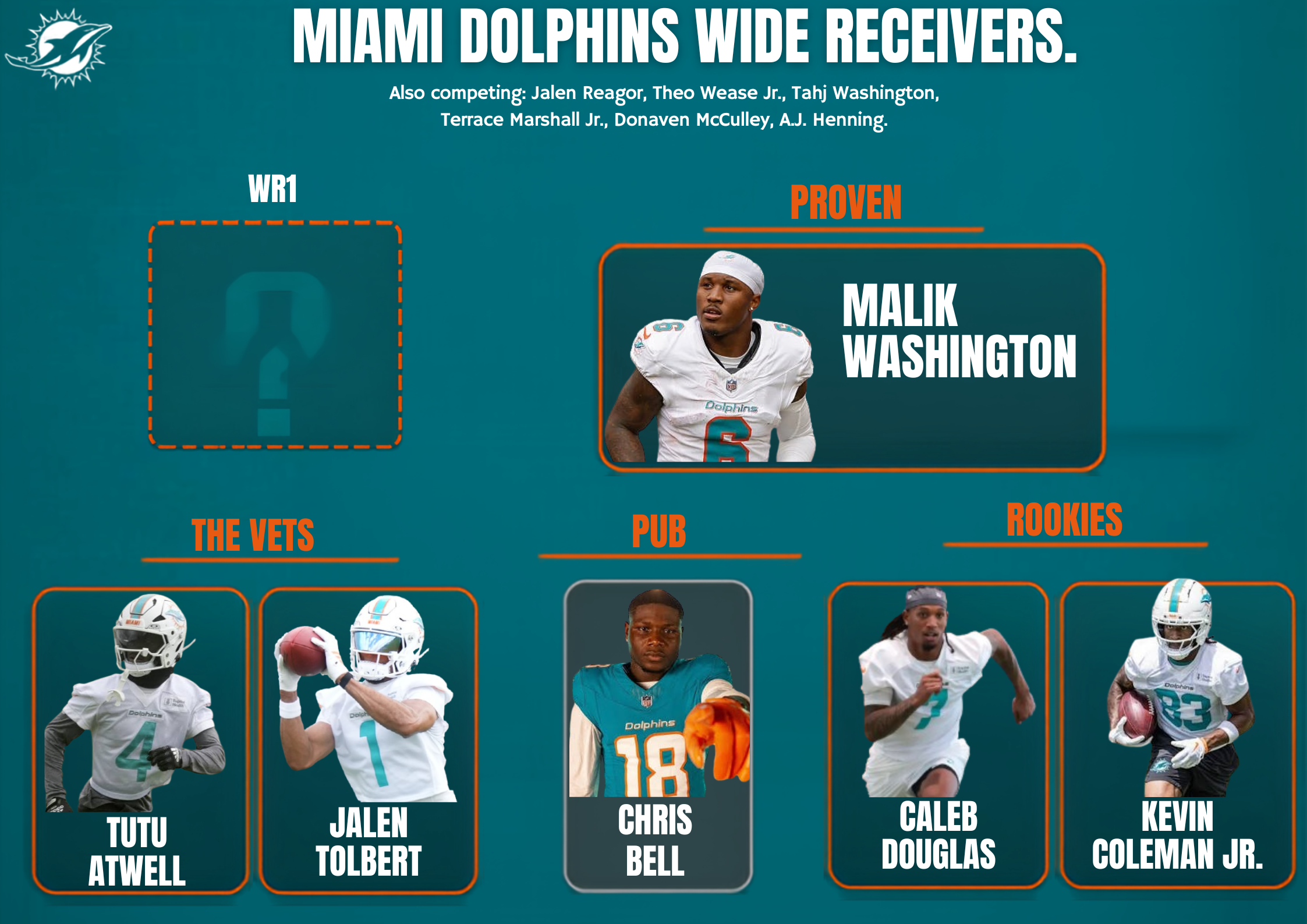
This is the one room on the roster that doesn't have an obvious answer, and it's the clearest need on the entire team alongside defensive backs. Malik Washington is the clearest returning contributor, posting 46 catches for 317 yards and 3 touchdowns in 2025, up from 26 catches as a rookie. He's a quality complementary piece, not a true number one.
The rest of the room is a mix of veteran prove-it deals and rookies, and that's exactly what makes it worth watching. There's real opportunity here for a rookie or a one-year veteran to actually earn snaps and carve out a role for himself. Tutu Atwell and Jalen Tolbert both signed one-year, near-minimum contracts to compete for starting roster spots, and Hafley has specifically praised Atwell's ability after coaching against him in the ACC.
Third-round rookie Caleb Douglas, at 6-foot-3 with legitimate deep speed out of Texas Tech, profiles as the outside "X" receiver this room is actually missing, assuming he cleans up the focus drops that showed up on his college tape. He's already building rapport with Willis, going back to Willis's time with the Titans.
Third-round pick Chris Bell is the name to watch once healthy. He's a physical mover with strong production at Louisville who tore his ACL late in his final college season, which is exactly why Miami got him near the end of round three instead of round two. He opens the year on the Active/NFI list. There's no reason to rush him back before he's fully right, especially on a team that isn't chasing wins this season anyway. Fifth-round pick Kevin Coleman Jr. has reportedly turned heads in spring practices with his quickness and slot separation, and the staff believes he can play outside as well as in the slot, which gives this room more scheme flexibility than the names alone suggest. Jalen Reagor, who Hafley personally pushed to add off a tryout, Theo Wease Jr., Tahj Washington, Terrace Marshall Jr., Donaven McCulley, and A.J. Henning are all competing for what's likely one or two remaining spots. Whatever this room looks like by Week 1, it still doesn't have a true WR1, and that's the single most important thing for this front office to fix by next offseason.
Bottom Line: Malik Washington is a good complementary piece, but this room still doesn't have its true number one. That leaves real opportunity for a rookie or a veteran to step up and earn the right to start.
Tight Ends
Greg Dulcich, re-signed to a one-year, $3.25 million deal with $1.5 million guaranteed, will most likely win out the starting job. He was one of the few consistent bright spots on Miami's offense last year, catching 26 of 33 targets for 335 yards and a 2.31 yards-per-route-run average that was easily his best mark since his rookie season in Denver. Third-round rookie Will Kacmarek gives this room its identity piece: an in-line blocker who graded above 69.0 in run blocking for three straight seasons at Ohio State. Asked directly about his value to an NFL offense built around the run game, here's how he described himself:
“You kind of hit on it a little bit. I think I’m a dominant run blocker. I think I’m a dominant blocker at the point of attack, but I don’t think people give me enough credit for my passing ability. I was used in an offense with tons of weapons so the opportunities were limited, but whenever I got the ball, like you said, I had sure hands, I caught it and I made the most of it.”
Fifth-round pick Seydou Traore is the developmental piece, an "F" tight end from Mississippi State by way of the NFL Academy who needs more route refinement before he's a weekly factor. Cole Turner and Ben Sims round out the room, and Turner is the more likely name to miss the initial 53 given the two rookies Miami just added at the position.
Bottom Line: Kacmarek pairing with Proctor as a blocking duo gives this offensive line the identity it wants up front, and Dulcich adds a real receiving threat at tight end for the first time in a while.
The Offensive Line
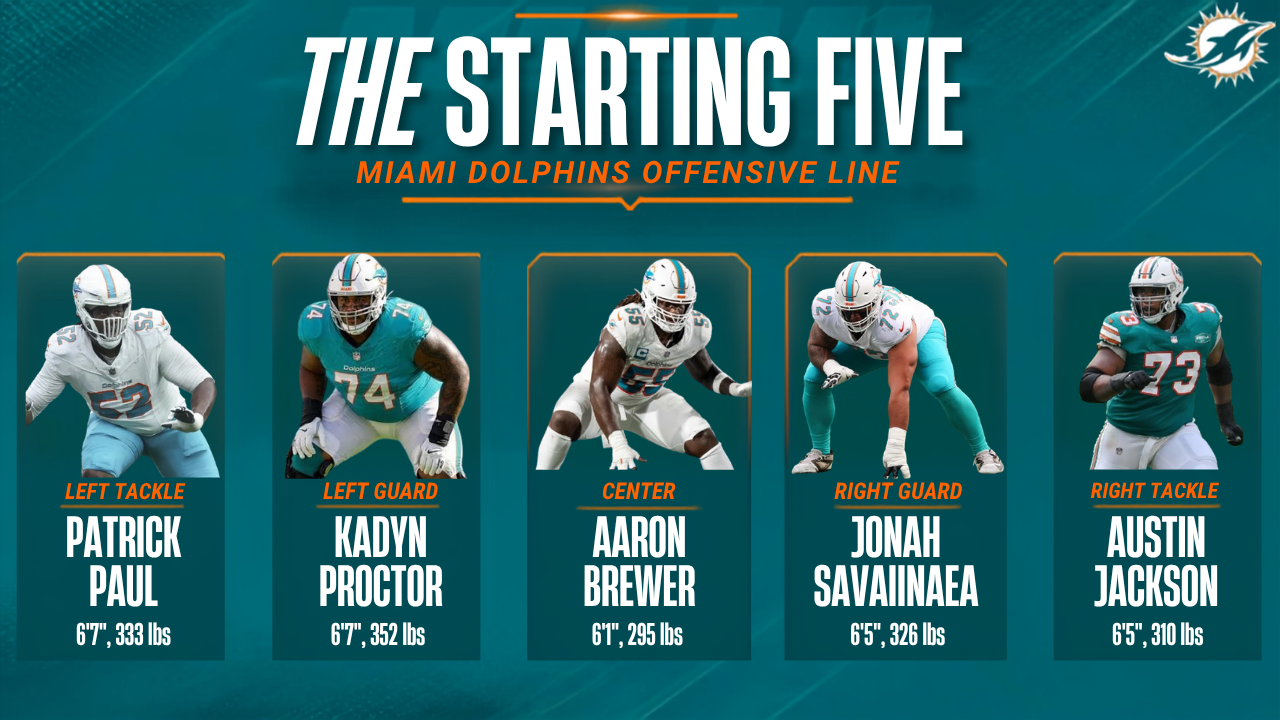
This group has a real chance to be one of the better offensive lines in the league, and it's the clearest evidence that this front office is building from the trenches out. It's also not a finished product. Jonah Savaiinaea is moving to a new position after a rough rookie year. Austin Jackson's health is an open question. And a rookie left guard needs to be dominant, not just solid, for this to actually work the way the front office is planning.
Patrick Paul broke out at left tackle last season, jumping from a 44.9 overall grade as a rookie to 66.2 in year two, with his pass block grade climbing to 74.4 and his snap share hitting 99.2 percent. Jordyn Brooks has already pointed to Paul specifically as a guy who's taken a leap heading into this season, and there's no reason to think that trend reverses in year three.
Aaron Brewer is the anchor. His 2025 season, 87.4 overall grade and a 91.5 run block grade, was the best of his career, and it's exactly why Sullivan extended him. He's already talked about what a full season of this new line, with Kadyn Proctor next to him, could actually look like on the field.
First-round pick Kadyn Proctor is the headline addition. At 6-foot-6 5/8 and 352 pounds with a 32.5-inch vertical that ranked in the 92nd percentile among offensive linemen, he's an athletic outlier for his size. He allowed only 2 sacks and 22 total pressures across 15 starts at Alabama last season, an 86.1 PFF grade. Miami is starting him at left guard, the position he'll actually settle into for now, and that stability should help him get comfortable faster than having him start at right tackle or learn more than one position. With Patrick Paul at left tackle next to him, that left side might be the biggest tackle-guard combination in the league, and Brewer himself has been genuinely impressed with how Proctor is attacking his rookie year.
“The mindset he’s coming in with is it’s like almost like a vet... He’s trying to do everything he can to get ahead of the eight ball, to not act as a rookie, and so I love that from him.”
Jonah Savaiinaea's rookie season was rough. He got turned around in pass protection, whiffed on blocks, and never looked fully comfortable at left guard, a position he never actually played in college. But he appeared to have settled down toward the end of the season, and Miami is now sliding him back to right guard, his natural spot at Arizona. If that move works the way the staff expects, this offensive line becomes a strength.
Austin Jackson is the wild card. When healthy, he's a legitimate NFL right tackle who can be trusted in the run game and to protect the quarterback. The problem is staying on the field. He's missed significant time in three of the last four seasons: an ankle injury in 2022 limited him to two games, a Week 9 knee injury ended his 2024 season early, and a lingering toe injury limited him to just six games in 2025, eventually requiring surgery and then a second cleanup procedure this offseason. His contract was restructured this year, and 2026 is very likely his last season in Miami regardless of how it goes. Hafley has publicly credited him for playing through pain last season even when he probably shouldn't have.
“You got to give Austin a lot of credit. Last year, he hurt his foot and a lot of guys in that situation would have opted to have surgery and got something done during it, but he battled through it.”
Charlie Heck and Jamaree Salyer were both brought in as low-cost tackle depth, and DJ Campbell, a sixth-round rookie out of Texas, gives this room interior depth as well. If Jackson can't stay on the field, or simply isn't retained beyond this year, Kadyn Proctor kicking outside to tackle at the end of the season is the most obvious answer, though with this decision that would reopen the left guard spot Miami just drafted him to fill.
Bottom Line: if Savaiinaea settles in at right guard and Jackson stays healthy, this is the best and most physical trench unit Miami has had in years.
Defensive Line
Zach Sieler is the leader of this room, signed to a three-year, $64 million extension in August 2025 that runs through 2029, an average of $21.33 million a year with $43.3 million fully guaranteed. His pure stats took a step back in 2025, 5.5 sacks compared to 10.0 in each of the two years before, after a 78.6-grade 2024 that was the best of his career. But stats undersell what he actually does. Sieler's value is in how well he reads an offensive line pre-snap, how he diagnoses double teams before they get set, and how much attention he commands from opposing blocking schemes just by lining up. That's exactly why Hafley wants him on this roster and why Miami is paying him like a top-tier player even in a down statistical year: every extra blocker sent his way is one less blocker on Kenneth Grant, the edge rushers, or the linebackers filling lanes behind him.
Kenneth Grant's calling card coming out of the draft was always the same: a run-stuffer first, with pass-rush skills that still needed serious refinement. His size and motor were why Miami took him 13th overall in 2025, not a finished pass-rush profile. His rookie box score reflected exactly that: 2 sacks, 2 tackles for loss, a 48.4 PFF grade, but he played over half of Miami's defensive snaps as a true rookie nose tackle and looked more comfortable as the season went on. He's spent this offseason specifically targeting the explosiveness that didn't fully show up on tape yet, and year two is a real chance for that development to translate into production.
He's also stepping into a leadership role in year two that rookies almost never get to occupy, bringing along a young room that needs it.
Jordan Phillips, the fifth-round pick out of Maryland last season, might have quietly had the best rookie season of anyone Miami drafted last year. He's a run-stuffer in the same mold as Sieler, someone whose strength is eating double teams and stopping the run cold at the point of attack, and for a fifth-round pick, the production was outstanding: 43.6 percent of the defensive snaps and 26 assisted tackles, a sign he was around the ball constantly all season long. There's real long-term upside here at nose tackle, and Miami's return on that fifth-round investment is already looking great. His pass rush is the clear area to develop, and year two is the chance to show it.
Zeek Biggers was the third and last defensive tackle Miami drafted in that same 2025 class, a seventh-round pick who opened the year on the practice squad and only played 9 games as a rookie. In those limited snaps, he proved he belongs in this league: he plays with energy, and he flashed real pass-rush ability, including a tackle for loss and a half-sack against New Orleans that showed he can collapse a pocket. His run defense is the obvious flaw that needs work, but a full year in the building under a new coaching staff should help. For a seventh-round pick, this is already outstanding value. Matthew Butler, re-signed this offseason, rounds out the rotation.
Bottom Line: this room's floor is Zach Sieler's veteran presence up front, and its ceiling is whatever Grant, Phillips, and Biggers turn into in year two.
Edge Rushers
Chop Robinson's career arc so far is the single most important storyline on this defense. His rookie season was genuinely good, a 70.0 grade and 6 sacks in 2024, and it raised expectations for a sophomore leap. Instead, 2025 was a step back: a 54.8 grade and 4 sacks. Now, with Jaelan Phillips traded away and Bradley Chubb released, Robinson isn't part of a rotation anymore. He's the guy this room is built around, and he's added weight, up to 265 pounds, specifically to handle the versatility Duggan's scheme demands, including kicking inside to a 4i or nose alignment when needed.
He's also been specific about what actually needs to improve, which is a good sign for anyone worried the sophomore dip was about talent rather than technique.
“Really just my eyes in the run game because my eyes was affecting everything else. So now that I got my eyes right, I feel like it’s my hands and my feet is doing it natural now.”
Hafley has been direct about what he wants to see translate to production.
“Hopefully he becomes an every-down player. I think the easy answer is his pass rush, his get off, his ability to affect the quarterback; but I’m looking for a lot more from Chop.”
Behind him, Joshua Uche and David Ojabo were both brought in on one-year, near-minimum deals, and both are exactly what that price tag suggests: guys who need to prove they still belong in this league and are worth a second contract somewhere. Uche's 2022 season with New England (11.5 sacks) shows the ceiling; the injury-shortened seasons since show the risk. Ojabo has never cracked a full-time role in four years in Baltimore, topping out around 41 percent of defensive snaps, but he's also carried a much lighter injury history than Uche.
Fourth-round rookie Trey Moore gives this room a pure speed-rush developmental piece, a 4.54-second 40 and a 38.5-inch vertical at 243 pounds, production numbers at Texas that came in lower than his college tape and measurables suggested he was capable of. Robert Beal Jr. and Cameron Goode round out the competition for what's likely one more roster spot.
Bottom Line: whether this edge group can get after the quarterback effectively and consistently, without Jaelan Phillips or Bradley Chubb next to Robinson, is one of the biggest swing factors on the entire defense.
Linebackers
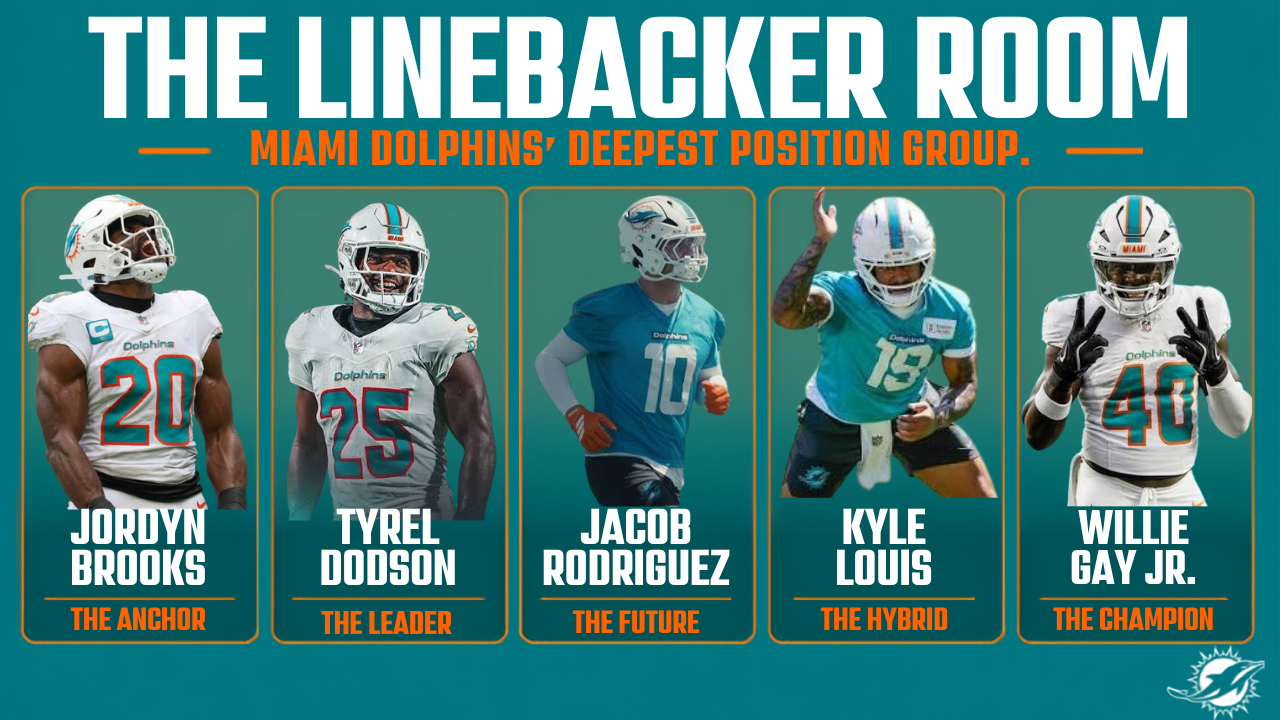
This might be the deepest, most talented room on the entire roster. Jordyn Brooks is the anchor, and his two seasons in Miami have been the best stretch of his entire career: a 71.3 grade and 97.8 percent snap share in 2024, then a 77.8 grade and 91.5 percent snap share in 2025, both easily his career highs after five seasons in Seattle. That's exactly why Sullivan extended him. Brooks has also become the emotional engine of this locker room's culture shift, and he's been vocal about it publicly.
Tyrel Dodson's role has grown every single year of his career, from an 8.6 percent special-teams snap share as a rookie in Buffalo to a full-time 89.9 percent starter's role in Miami last season, where he racked up 129 tackles. His best-graded season was actually 2023 in Buffalo on a part-time role, so the challenge now is turning full-time reps into full-time production. He's also been the one making the case, publicly, for what it means to have this much young talent added to his own room rather than being threatened by it.
“I’m still here, why would it be a disadvantage? It’d be a disadvantage if I were shipped off somewhere and not willing to compete. I’m here another year in the league, undrafted, man. Leader of men, that’s who I am.”
That's exactly the role he's stepping into with Rodriguez and Louis in the room now, a veteran who came into this league undrafted and had to fight for every rep, now in position to help the rookies the same way someone once helped him.
Willie Gay Jr. brings something this room genuinely needed: a player who's already won at the highest level. He was part of Kansas City's Super Bowl teams, playing 88 percent of the snaps in one Super Bowl and 52 percent in another, and he plays his best football in zone coverage and blitz packages rather than a rigid assignment scheme. Realistically, he's a depth and rotational piece with starting-caliber upside if he's needed, a strong special teams contributor, and, alongside Dodson and Brooks, another veteran voice mentoring the rookies at the position.
Then there's Jacob Rodriguez, who was my favorite linebacker in the entire draft class, and it isn't close. As a senior at Texas Tech, he put up 128 tackles, 11 tackles for loss, 4 interceptions, 10 pass breakups, 2 fumble recoveries, and an FBS-leading 7 forced fumbles, on a defense that led the country in yards per play allowed. He won the Bednarik, the Butkus, and the Lombardi, and finished fifth in Heisman voting as a linebacker. His 93.0 PFF grade was the highest of any Miami draft pick this year. He started his college career at quarterback before converting to linebacker, and that background shows up constantly on tape: he reads a quarterback's eyes and processes offensive concepts faster than almost anyone else at the position in this class. He's a true difference maker and a turnover machine, and Miami views him as the long-term successor to Dodson at the position. Brooks, a fellow Texas Tech alum, was already a fan of his before the draft.
“Anybody that was in the building last year knows how much of a fan I was of Jacob, just watching him from afar and seeing how he kind of willed Texas Tech to a playoff appearance... When he got drafted, I felt like I was getting drafted.”
Rodriguez has also talked openly about the mentorship that's shaped him, including a lasting relationship with Hall of Famer Zach Thomas.
Behind the top four, fourth-round rookie Kyle Louis is one of the more athletic, versatile players Miami added in this entire draft class. He racked up 81 tackles, 8.5 tackles for loss, and 3 sacks in his final college season, with real range and pursuit speed to go with legitimate coverage ability. He's built to cover tight ends and running backs out of the backfield, hold up against the run at the second level, and drop into nickel packages on passing downs, which is exactly the multi-tool piece Duggan's scheme wants on the field for specific situations rather than a straight snap-count starter.
He may lack the ideal size and physicality teams typically want at the position, but that's exactly why he fits so well in this specific room. With Jordyn Brooks anchoring the run game and Tyrel Dodson doing the same next to him, and Jacob Rodriguez already handling the instincts and playmaking, Louis gives Duggan a hybrid piece he can move around in coverage-heavy packages without asking him to be a between-the-tackles thumper. Jackson Woodard and Ronnie Harrison Jr. round out the room's depth.
Bottom Line: this is the deepest room on the roster, and the only real question is how Duggan chooses to divide snaps between these five players.
Cornerbacks
This is the room with the most eyes on it, and for good reason: it's led by a rookie, and there isn't a lot of proven depth behind him.
Chris Johnson, Miami's first-round pick out of San Diego State, was actually my third-ranked corner in this entire draft class heading in. He moved up to second on my board once the news came out about Jermon McCoy's knee and the possibility that it's a degenerative issue that could shorten his career. On tape, Johnson is a scheme-versatile corner with fluid hips and an aggressive, physical play style, exactly the profile Duggan's press-man defense is built around. It also doesn't hurt that Hafley himself built his coaching career as a defensive backs coach before he ever ran a defense or a program. That background shows up in how specifically this staff talks about developing corners, and watching that experience get applied to this room, Johnson especially, is one of the more interesting subplots of this whole season.
Hafley has been similarly direct about how highly this staff valued him on draft weekend.
“This was one of my favorite guys in the draft that when we started talking about him and it came time to pick him, I mean, I would not have been surprised if he was taken earlier than we took him.”
His college production backs it up: 4 interceptions, including 2 returned for touchdowns, 9 pass breakups, and a 92.4 PFF coverage grade as a senior. His one notable weakness on tape is a 30 5/8-inch arm length that can get exposed against bigger receivers on contested catches, which is worth watching as he adjusts to NFL size at the position.
Behind him, the picture is thinner than any team wants heading into a season. Storm Duck has flashed since going undrafted in 2024, 35 tackles as a rookie, but his 2025 season ended just 15 snaps into the Week 8 game against Atlanta on October 26, a knee injury that landed him on season-ending injured reserve. He was limited through OTAs and minicamp this spring while still working back from that rehab, and Miami placed him on the Active/PUP list on July 23 ahead of training camp, which leaves his actual return timeline for preseason unclear. Whether he can be trusted to start opposite Johnson is a legitimate question.
JuJu Brents, acquired from Indianapolis last year, actually posted the best grade of his career in limited Miami action, 74.5 in 2025, and there's real talent in his profile: elite physical tools at 6-foot-3, 198 pounds, with arms over 34 inches, and his best play comes in zone coverage. The concern is availability. He's dealt with wrist, hamstring, quad, and a torn ACL across his career and has never strung together a full healthy season of consistent play. The ceiling is genuinely high, and if Hafley's staff can keep him on the field, it's worth finding out how high.
Jason Marshall Jr., a fifth-round pick a year ago, quietly had a solid rookie season for where he was drafted. He looked like a legitimate depth corner with real starting-level potential, and his best play came on the outside rather than in the slot, even though limited depth forced him into nickel snaps as a rookie. He's physical, doesn't shy away from tackling, and tested as a good athlete. Hafley has already said he envisions Marshall at his natural spot on the outside going forward rather than back in the slot, which puts him squarely in the competition for the second cornerback job.
Ethan Bonner has earned praise from teammates and coaches and has flashed in big moments when his number's been called. At 6-foot-1, 190 pounds, and 26 years old, he's mostly been a depth, rotational, and special-teams player so far, but the way this room is currently built, there's real room for him to carve out a bigger role. If Hafley's staff can turn his athleticism and physical coverage traits into consistent weekly performance, that's exactly the kind of depth swing this room needs.
Marco Wilson, Darrell Baker Jr. (currently on the Active/PUP list after signing following a starting role in Tennessee), and Alex Austin round out the veteran competition. A.J. Green, Miles Battle, and Ethan Robinson give the room developmental and rotational depth.
Bottom Line: Chris Johnson has the CB1 job locked down as a rookie. Everything behind him, Brents, Marshall, Duck, and Bonner, is a real, wide-open competition, and how that shakes out determines whether this defense's biggest question mark turns into a strength or stays a problem.
Safeties
Dante Trader Jr., a fifth-round pick a year ago, overdelivered for where he was drafted. He played a full, healthy rookie season and was good in run support, finishing with 55 tackles, a pass defended, and a forced fumble that he recovered himself. Hafley has already made clear how much he values what Trader brings beyond just his skills on the field.
“Dante loves football. He’s always here. He’s always in the building. He’s always asking questions. He practices so hard. He’s so intentional.”
There's real room for growth here, particularly in coverage and deep-zone responsibility, but for a fifth-round pick this was an overdelivering rookie season built on instincts, a disciplined approach, and strong communication in the secondary. He's in a strong position to start again in 2026 and keep developing from there.
Michael Taaffe's story fits this new regime about as well as any player on the roster: a walk-on at Texas who became an All-American, exactly the hungry, football-obsessed identity Sullivan and Hafley are trying to build. His tape shows real football IQ, he's a natural leader, and he brings genuine special teams value. He fell to the fifth round because he lacks elite length, size, and top-end speed, not because of what shows up on tape. What he brings to this room, leadership, a locker room presence, depth, and a core special teams role, is substantial value, and he's the kind of player who fights for every rep rather than waiting to be handed one.
Louis Moore, a priority undrafted free agent out of Indiana, has shown good coverage ability, particularly in zone, and is another high-IQ player fighting to earn a roster spot in camp. If he does, there's a real path for him to become a versatile, trusted piece in this secondary.
Zayne Anderson, a special-teams ace out of Green Bay, Lonnie Johnson Jr., Omar Brown, and Major Burns round out realistic depth behind the top three.
Bottom Line: Trader is a legitimate building block at safety after a strong rookie year. The real question in this room is who starts next to him, Lonnie Johnson, Zayne Anderson, and Taaffe are all in that conversation.
Special Teams
Miami completely overhauled its specialists room this offseason. Longtime kicker Jason Sanders was released, and I believe Riley Patterson wins this job. He appeared in all 17 regular-season games in 2025 after stepping in for an injured Sanders, converting 27 of 29 field goals (93.1 percent) and 34 of 35 extra points (97.1 percent) for 115 total points on a 76.1 PFF field-goal grade. Zane Gonzalez, who converted 19 of 22 field goals for Atlanta last season, is the competition, but Patterson's body of work in Miami should be enough to hold the job. Bradley Pinion takes over at punter and Tucker Addington is the long snapper.
Bottom Line: after a full season in Miami, Patterson has already earned this job. Gonzalez should be the insurance, not a real threat to take it.
The Cap Picture
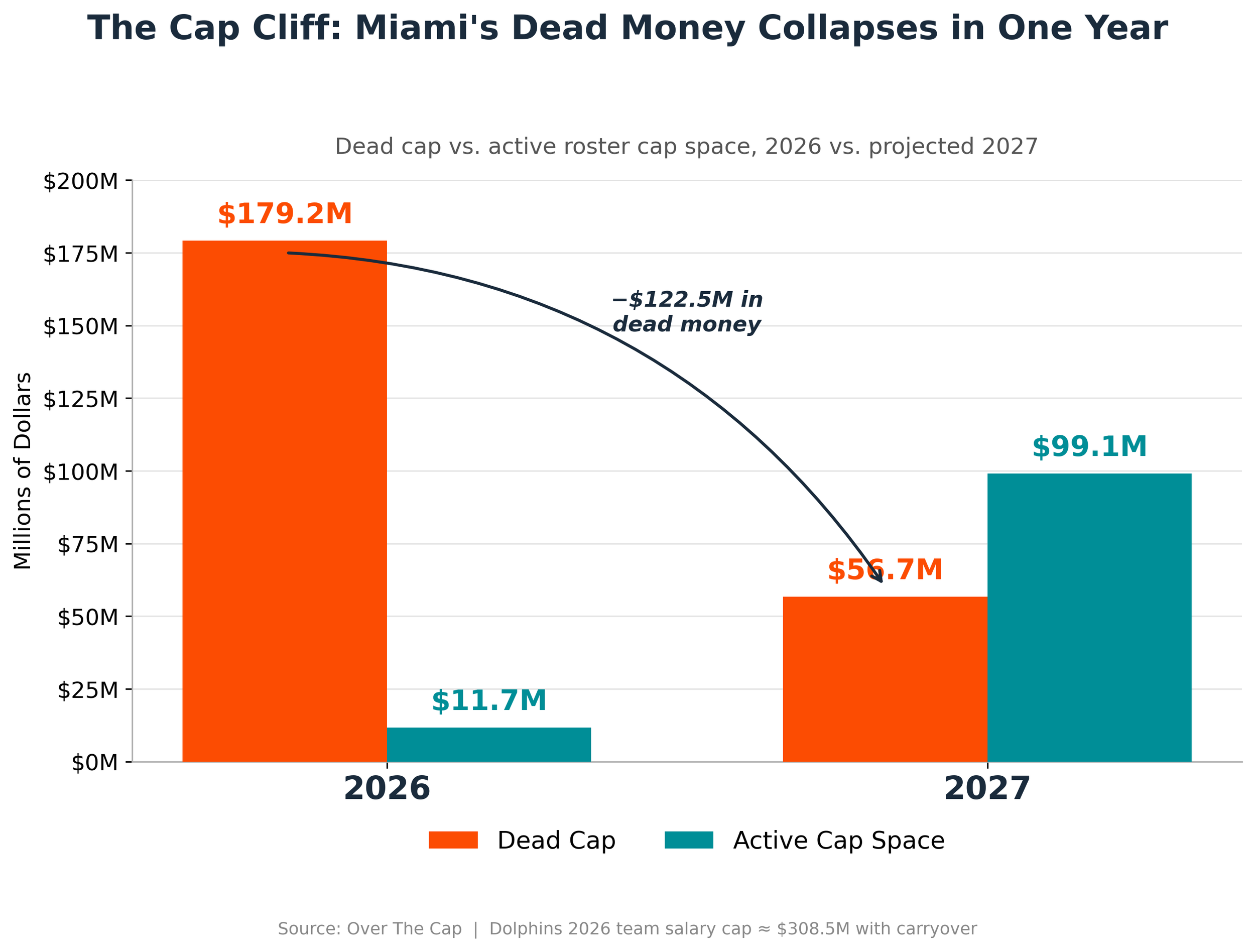
The tank narrative around this team comes from everything happening at once: a new GM, a new head coach, releasing Tua, Tyreek, and Chubb, trading away Waddle, and on top of all of it, a genuinely historic dead cap number. That number, specifically, is $179,214,257 for 2026, more than 58 percent of a team salary cap that sits at roughly $308.5 million with carryover included, the largest total in NFL history, more than the previous record of $127.7 million the Texans set in 2022. Active roster cap space sits at $11.66 million right now.
The dead money isn't evenly spread. It's dominated by five names: Tua Tagovailoa at $55.4 million in 2026 with $43.8 million more deferred to 2027 via a post-June 1 designation, Tyreek Hill at $28,248,750 absorbed entirely this year, Jaylen Waddle at $23,228,128 in remaining proration from the Denver trade, Bradley Chubb at $10,972,742 this year with $12,886,500 more deferred to 2027, and Jalen Ramsey at $20,868,000, the one name on this list that isn't actually this regime's decision, it's the remaining proration left over from the 2025 trade to Pittsburgh under the previous front office.
That last detail matters more than any other number in this section. Sullivan didn't spread the pain out to protect this year's optics. He took the bulk of it now, on purpose, so that by 2027 almost none of it is left. Strip out this year's moves, and Miami's entire 2027 dead money ledger is Tua's $43.8 million and Chubb's $12.9 million. Nothing else.
The payoff: Miami is currently projected at $99.1 million in cap space for 2027.
2027 Draft Capital
On top of that cap space, Miami keeps its own first, second, third, fourth, fifth, and sixth-round picks in the 2027 draft, plus an extra fifth-rounder acquired from Pittsburgh in a 2025 trade. Their own seventh-rounder was sent to Pittsburgh in that same deal, but there's a conditional seventh coming from the Giants as part of the Darren Waller trade, and OverTheCap projects decent odds at an additional late compensatory seventh on top of that. It won't be the 13-pick haul this year was, but it's a full, healthy draft slate layered on top of nearly $100 million in cap room. Need, not budget, is going to drive next offseason's board, and that board will keep shifting between now and next March as trades, extensions, releases, and draft prospects around the league rise and fall.
The Bottom Line
The record itself is the wrong way to grade this season. Miami is playing the second-hardest schedule in the NFL, with the 49ers, Chiefs, Bengals, Patriots, Lions, Bills (twice), Broncos, Bears, Packers, and Chargers all on it. Three to Five wins is a realistic range. This is a team setting the foundation for a run at a Super Bowl.
Miami didn't set the worst cap number in NFL history because they gave up. They set it because they'd rather take the pain in one season than let it linger across four. The extensions, the Willis contract, the Waddle return, the draft class built entirely around trench physicality and secondary length, all of it points the same direction: this is a front office with an actual plan, not a front office hiding behind a rebuild label while it figures things out.
Whether that bet pays off won't show up in this year's standings. It'll show up in what this roster actually looks like in 2027, when the dead money is gone, the flexibility is real, and there's no more record left to hide behind.
